Protecting performing bodies A review of prACTice: A Living Journal for Actors + Artists
A review of prACTice: A Living Journal for Actors + Artists, exploring exploitation, consent, trauma and safety in the performing arts. It highlights the need to protect performers’ bodies, dignity and creative freedom through 50 powerful principles of self-empowerment and resistance.
A performer’s body is an indeterminate thing. It behaves simultaneously like a shape-shifting mutant and swaddles its parts as soon as the curtains are drawn. Visibility is its primary referent, and viscosity its essence. Strangely the gap between audience and performance, the auditorium dark and the stage / screen light, between inertia and movement is the element that alters performers into mythological, dreamlike images. Even the insubstantial dividing space in intimate theatre or spoken word poetry is imperative for maintaining the illusion of artistic distance. Precisely why Marina Abramović’s explosive experimental performance in 1974 was not simply a provocation to the spectators to transform into participants, but the vulnerable body itself was rewritten with brute force by the 72 items on the trestle table.
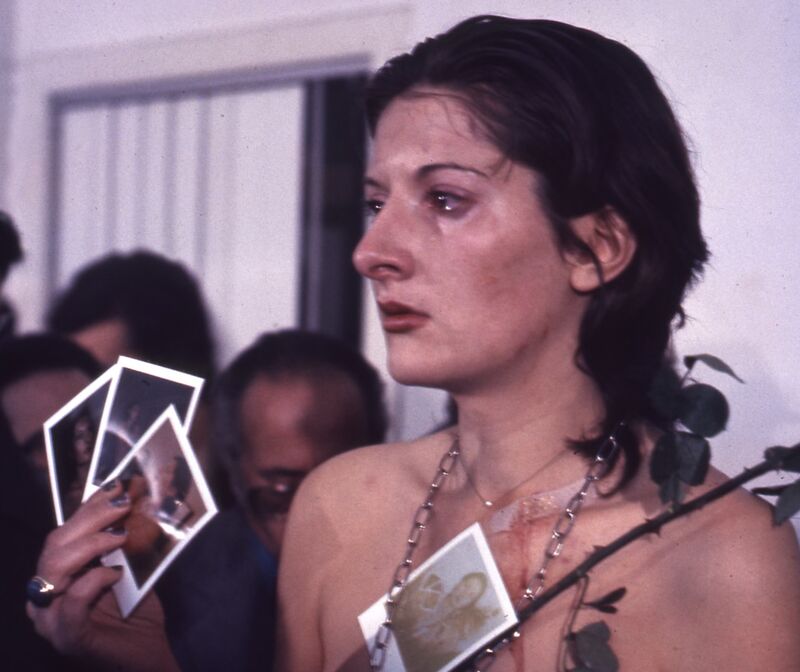
Marina Abramović during Rhythm 0 (1974)
But how do we read bodies that are violated in the name of art and realism, in rehearsal rooms, in the mentor’s house or the sacrificial / inspirational bodies of muses, abused before the camera begins recording or attacked in hotel rooms under the influence or disabled bodies turned down and cast outside performance zones? Through this article we are striving to arrive at a compassionate inquiry into the precarity of the visibility sector – issues related to mental health, body dysphoria, exploitation, safety, consent, trauma, empathy, and suggest a collection of fifty ways to smash the iron chains of silence and violence.
There is always something bizarre and baffling about influential and inspiring artists turning out to be predators. Suddenly, a personal space has been breached, a feeling corrupted, and a love ruined. The shelter of a guide turns out to be a lair of the beast. The horror doesn’t always stem from personal experiences of damage and perversion; assault on the powerless anywhere is infringement of safety everywhere. Under these conditions, how does the grieving self interpret the terror of loving terrible individuals? The blistering bleeding heart of the wounded loses both credence and conviction in the art itself. Art turns into a pharmakon – a healing medicine and an intimate poisonous thing. It is no longer empathy and forgiveness, emotion and subjectivity, care and tenderness. An artist’s transgression ruptures the halcyon days for both audience and practitioners. From the legendary Hitchcock sexually harassing Tippi Hedren, and Roman Polanski raping thirteen-year-old Samantha Gailey, to rape allegations against Bill Cosby; Michael Jackson’s maltreatment of children; god-like David Bowie having sex with teens; Picasso subjecting “his” women to crushing animal sexuality; the jazz legend Miles Davis ritually slapping Cicely Tyson and choking her career as a Broadway dancer; Hemingway’s sickening nature of beating his wives; Maria Schneider felt “a little raped” by Marlon Brando and Bertolucci on the sets of Last Tango in Paris; and finally, trickling down to accounts of gross indecency by Harvey Weinstein; Woody Allen sleeping with the child of his partner Mia Farrow; Kevin Spacey trying to seduce fourteen-year-old actor Anthony Rapp; and the recent Hema Committee’s report on the deplorable working conditions of women in the Malayalam film industry— all these terrifying records of oppression and preying aren’t simply biographical excesses of giant geniuses and their rockstar virility. These are also narratives of docile and compliant bodies (of women) that were blinded, entranced / censored, muted / reduced, defeated by a system and tradition that perceived them, in the words of Picasso, as “machines for suffering”. Performers are grinded by their form in the name of realism, method, believability, and cast out as an overused, depleted byproduct. Perhaps, one of the ways out of this cheap pastiche of history is to poleaxe the frozen mass of systemic enslavement.
We are aware that artists are not emissaries of moral and ethical behaviour. They are reproducible images – consumed, revered, condemned. Cancelling a perpetrator or stopping consumption of their art isn’t equivalent to knocking off the crime from happening. In fact, the artist’s monstrosity is evidence of our own ‘unnatural’ tendencies and grotesqueness. Therefore, a work of art is often a complex and ambivalent meeting of two biographies – of the artist and the audience. The artist, far from being dead, is often entangled in the internet of things, in eccentric parasocial bonds with their followers. However, our objective here is not to identify and observe the traits of dominant and compelling artists (akin to Claire Dederer), but rather to construct a safehouse for impassioned performers to thrive and grow out of harm’s way. We do not want to mourn another (radical) feminist like Valerie Solanas ending up in jail for shooting Andy Warhol or another Sylvia Plath ending her life by inhaling carbon monoxide.
Therefore, as comrade, victim and teacher, Daminee Basu, in her radical journal of silent spaces and personal stories, prACTice, advocates this exhaustive list of self-empowering tools and therapeutic exits for all performers, everywhere:
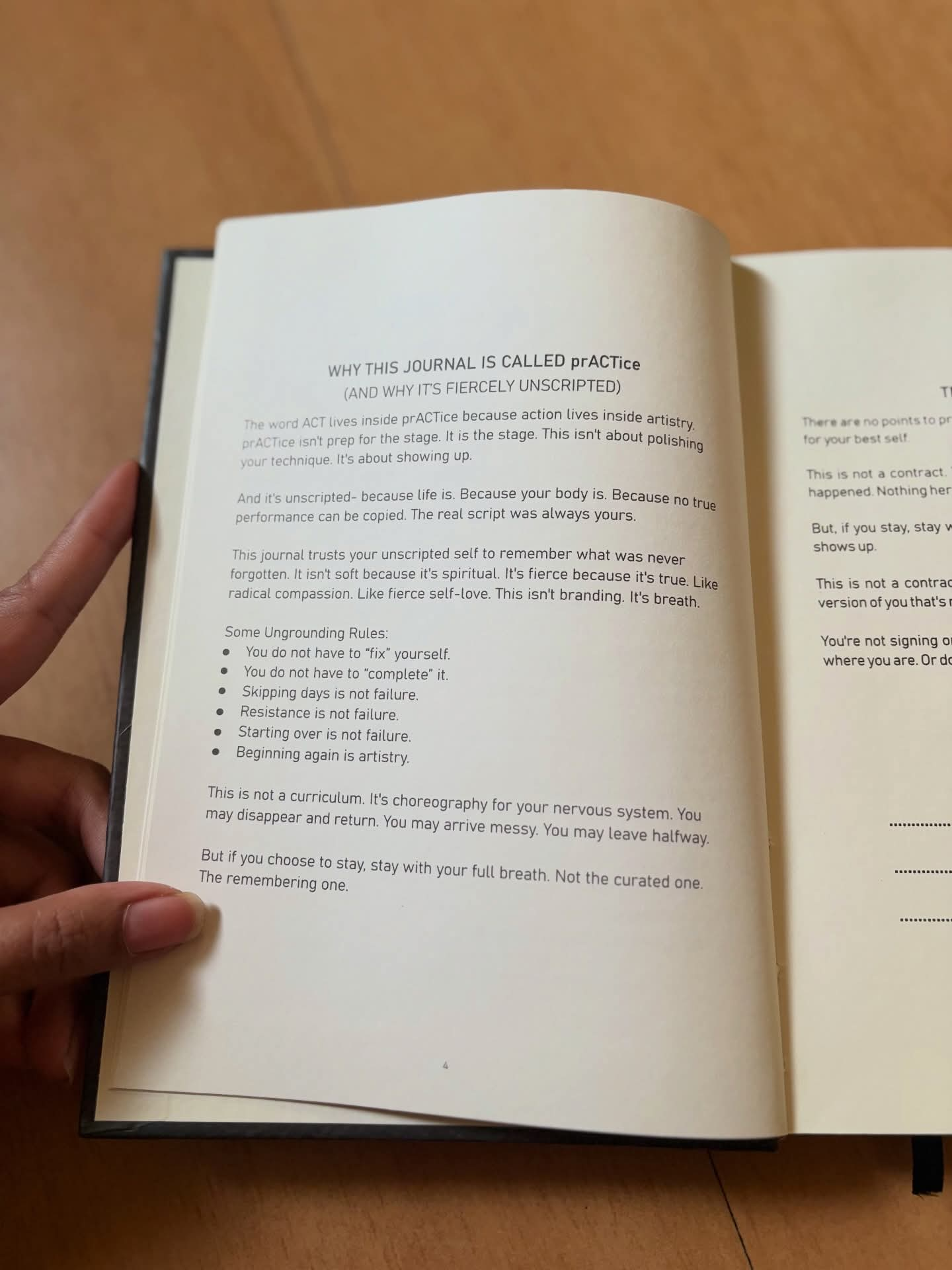
prACTice: A Living Journal for Actors + Artists
1. You are not just a product. You’re Creation, 2. Your trauma isn’t a tool for someone else’s vision, 3. Your labour is real. It deserves to be honoured and remunerated, 4. Pain is not proof of your passion. Rest is not a crime, it’s a craft, 5. Not all friction means you’re learning. Sometimes it’s just harm. Choose clarity over chaos, 6. Coercion is not chemistry. That weird vibe is not “creative tension”. If it feels off, it is wrong, 7. You don’t owe anyone your vulnerability. Your body is not a rehearsal prop, 8. You’re allowed to walk away. Even from a “dream project.” Your exit is your power, 9. Obedience is not professionalism. Professionalism is care, clarity, and consent in practice—not silence, fear, or shape-shifting. Saying no is part of your practice, 10. Tears are not a training method. Rehearsals shouldn’t leave you shattered, 11. You are not replaceable. That threat is control, not truth, 12. You are not a muse. You’re not here to decorate someone else’s genius. You are the creator, not the accessory, 13. Silence isn’t professionalism. Swallowing pain doesn’t make you strong, 14. “Tough love” is often just abuse. They don’t get to break you to build you. Respect is the only real method, 15. Being seen is not the same as being safe. Fame can be a spotlight or a sniper scope. Visibility is not protection. Boundaries are, 16. You don’t have to earn your basic rights. Safety isn’t a bonus. It’s a baseline. Dignity is non-negotiable, 17. Gratitude shouldn’t feel like grief. “Be thankful” is often the code for “Don’t complain”, 18. Rest is not rebellion. It’s repair. Your body is not their schedule, 19. Manipulation is not mentorship. Pressure is not trust. Real teachers don’t blur boundaries, 20. You’re allowed to be “difficult.” It means you’re not easy to exploit. Call it discernment and self-respect, 21. You don’t have to audition your boundaries. “Can you handle it?” is not a spiritual test. ‘No.’ is a full sentence and a performance, 22. Your nervous system is not a machine. If your body says “I’m not okay,” listen. Stop pushing, start protecting, 23. You don’t owe them your pain. Your past is not public property. Your withholding is power, 24. Not all teachers are safe. Degrees and awards mean nothing if they harm. Trust the ones who honour your agency, 25. It’s okay to unlearn the hustle. Your worth isn’t measured by your exhaustion. Success doesn’t require self-destruction, 26. Your self-respect is more important than a role. No gig is worth your dignity, 27. You don’t have to be “strong” all the time. Softness is not weakness, it’s survival. Let your tenderness speak too, 28. Power doesn’t mean truth. Charisma can be a mask for control. Don’t confuse charm for care, 29. Feedback is not always sacred. You’re allowed to reject advice that crushes you. You get to choose what enters your soul, 30. Not every opportunity is worth it. Sometimes “big breaks” break you, 31. You can love the craft and hate the conditions. This isn’t hypocrisy, it’s honesty. Stay in the work, not in the abuse, 32. A set is not a battlefield. You don’t need to “toughen up” to belong. You deserve emotional and physical safety, 33. Being visible doesn’t make you less human. Followers aren’t protection from harm. You still deserve care, even when you shine, 34. You don’t need to suffer to be “real.” Your worth isn’t in your wounds. Joy is just as valid. So is rest, 34. You are not an object. Don’t let their gaze turn you into a thing. You are one unique living, breathing, thinking being, 35. Romanticising struggle is how they trap you. It’s not poetic, it’s structural. Demand systems that don’t devour you, 36. Your body is not a sexualized machine. Overexposure is not bravery, it’s burnout. You control the lens and you set the terms, 37. No “opportunity” is urgent enough to harm you. Scarcity is a tactic. You’re allowed to Pause. Breathe. Choose, 38. You are not a vessel for someone else’s ego. You don’t have to carry their vision on your back. Collaboration must include care, 39. You’re allowed to call it abuse. Even if everyone else claps for it. You’re not dramatic, you’re discerning, 40. You are not “too sensitive.” You’re tuned in, not weak. Sensitivity is intelligence, honour it, 41. You can quit and still be an artist. Walking away isn’t failure. It’s freedom, 42. You’re not the only one feeling this. The system isolates to survive. There’s a whole wave of swelling chorus waiting for you to speak, 43. You deserve community, not competition. The hustle is designed to divide us. Find your people. Build safety, 44. Unlearning abuse is part of the work. Being here doesn’t mean being hurt. You’re allowed to seek help and do things differently, 45. You don’t have to prove your pain. You’re not auditioning for empathy. Your feelings are already valid, 46. They don’t get to keep you silent. Secrets protect them, not you. You can speak when you’re ready, 47. Safety is not selfish. Your body is not collateral. Your care, every day, in small and sacred ways, is the revolution, 48. You are not alone. Even if you feel like it backstage, online, or on set. We’re out here. Finding each other, 49. You are allowed to take up space. Emotionally, physically, creatively. Stretch. Breathe. Expand, 50. You are the art. Protect the instrument. Without you, the work doesn’t exist.