Bengal Birders' Meet puts citizen science at the heart of conservation
The two-day Bengal Birders' Meet 2026 in Kolkata showcased how birdwatching is evolving beyond a hobby into a powerful tool for citizen science. Bringing together researchers, conservationists and young naturalists, the conference highlighted education, technology, community participation and grassroots action as the future of biodiversity conservation.
A conversation on birds quickly became a conversation about people, wetlands, poisoned landscapes, technology, children and the future of conservation at the two-day Bengal Birders' Meet 2026, organised by the Birdwatchers' Society (BWS) in Kolkata.
Rather than treating birdwatching as a niche pastime, the conference presented it as a bridge between science and society. Researchers, conservationists, birdwatchers and students shared a common platform to discuss how public participation can strengthen biodiversity conservation at a time when habitats are under increasing pressure.
Held on July 18 and 19 in Kolkata, the conference reflected a broad conservation vision. The guest of honour’s address was delivered by the Chief Wildlife Warden of West Bengal, while the keynote speaker’s address was delivered by Mr. Ravi Singh, CEO, WWF. Dr. Sonali Ghosh IFS, Council Head Forest BTC and FD, Manas Tiger Reserve, spoke on the birds of Kaziranga and Manas.
Dr Prachi Mehta, Director of the Wildlife Research and Conservation Society (WRCS), spoke on owl conservation, highlighting the ecological importance of owls. Ms Vasudha Mishra of HEAL delivered a session on the drive against the poaching of larks in central Bengal, drawing attention to the continuing illegal trapping of the migratory birds and the need for stronger community participation to curb the practice. Lester Perera, environmentalist, bird artist and birder from Sri Lanka, presented an illustrated session on the birds of Sri Lanka, introducing the audience to the island nation's rich avian diversity and its unique bird habitats.
Technology and research formed another important thread of the conference. Dr Subham Banerjee explored how bird sounds can reveal the health of ecosystems, demonstrating the growing role of acoustic monitoring in ecological research. Atharva Singh of CSIR-NEERI showed how Geographic Information Systems (GIS) are increasingly helping bird monitoring move beyond species lists to inform conservation planning. WWF-India's Dr Dipankar Ghose spoke about the opportunities and challenges facing bird conservation in India, stressing the importance of partnerships between scientists, governments and citizens.
The conference also celebrated stories from the field. Sandip Das of BWS and Dr Kaushik Deuti, of the Zoological Survey of India recounted the remarkable journey of rediscovering the Spoon-billed Sandpiper along the East Asian-Australasian Flyway, while Kousheyo Bagchi reflected on how childhood curiosity evolved into a lifelong passion for birds.
Among the highlights of the conference was a performance by children from the School of Birds programme. Participants from the School of Birds programme staged Jolabhumi Banchate Hobe (Save the Wetlands), a puppet performance developed with Disappearing Dialogues. Based on real incidents from East Kolkata Wetlands, the play portrayed the impact of untreated chemical waste from nearby leather factories on people, livestock and wildlife, reminding the audience that environmental degradation is never an abstract issue.
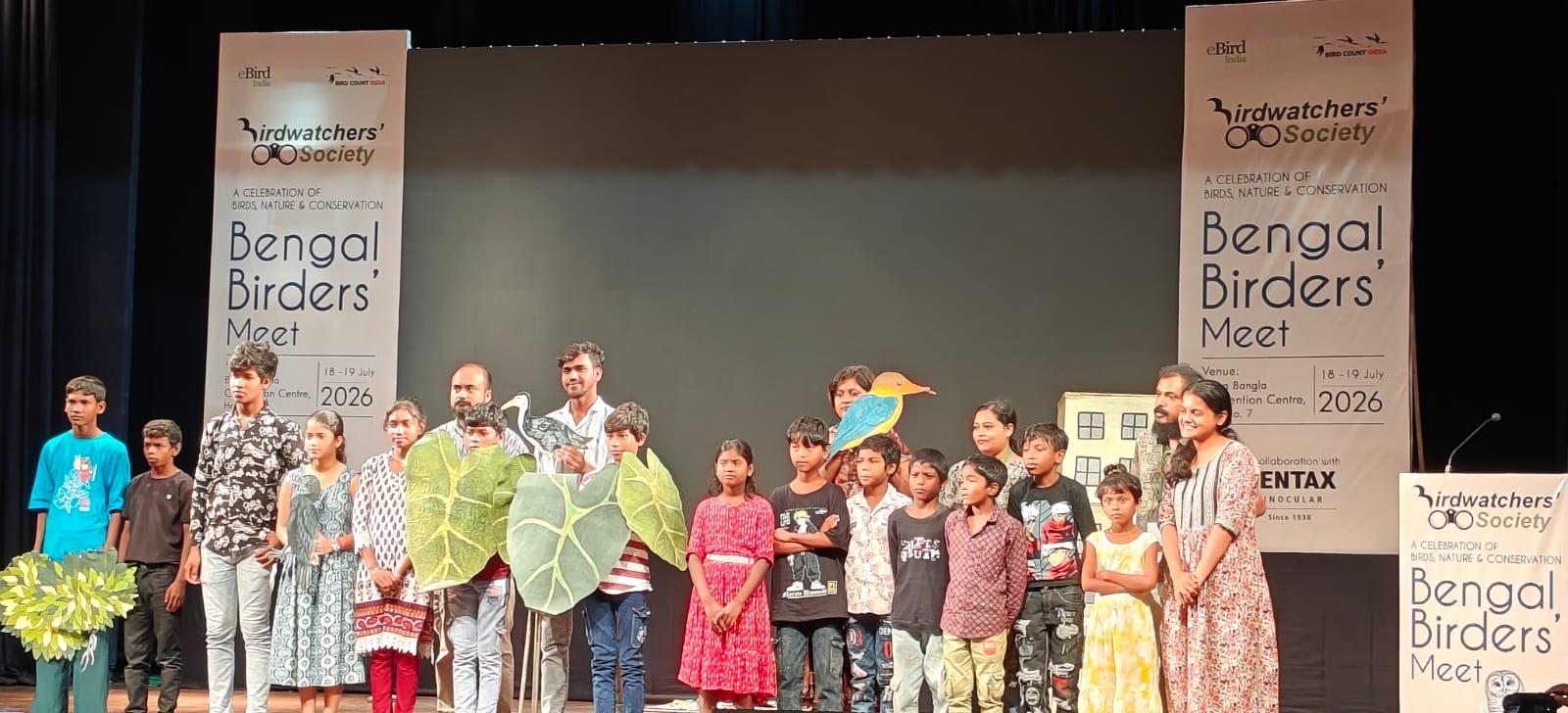
Young naturalist Agastya, popularly known as the "Butterfly Boy", echoed that message through his own experience.
Exploring the natural world is one of the most rewarding things we can do. It really changed my perspective. It gave me a sense of appreciation for all the life around us. Now I notice so much more—the insects in my backyard, the birds in the trees,- he said
Events like the Bengal Birders' Meet help bridge the gap between scientific research and the public. "When we, the scientists, work, our work stays limited to publications and reports. But programmes like these allow us to share our findings with a much larger section of society,"
-Dr Prachi Mehta
For BWS, that public engagement is central to its mission.
"Our objective is to make birdwatching more than a recreational activity. We want people to see it as citizen science. Every observation contributes to our understanding of biodiversity, and conserving birds is possible only when communities, institutions and organisations work together,"
- Assistant Secretary Dr Kanad Baidya.
If the two-day meet carried a single message, it was this: conservation is no longer the preserve of experts alone. It belongs equally to researchers, schoolchildren, birdwatchers and ordinary citizens willing to pause, observe and record the living world around them.

