The Dimagi Naxal doctrine. Why the Right needs you to stop thinking
Dimagi Naxal is emerging as a political shorthand for delegitimising dissent, with its amorphous definition allowing ideological labelling to spill into campus intimidation, identity-based targeting and the policing of critical thought.
By half past midnight on August 19, a mob of fifty to sixty men had pushed past the gates of Jadavpur University, hurled stones and eggs at a student’s gathering inside the administrative building, and, in a detail that is conveniently metaphorical for this article, trampled the university's historic emblem designed by Nandalal Bose. CCTV footage later revealed ABVP office-bearers and BJP-linked individuals at the scene. At a press conference the same week, ABVP leaders in West Bengal described the operation as putting ‘the last nail in the coffin’ of the university's ‘Dimagi Naxals’, and promised to finish the job soon. West Bengal’s Chief Minister Suvendu Adhikari echoed these statements in his Bidhan Sabha Speech on September 10, adding on an additional threat of cutting students who support Palestine ‘into pieces’.
The Dimagi Naxal phrase was only four days old at that time. On his Independence Day address, Prime Minister Narendra Modi stated that while armed Naxalism had been defeated a subtler enemy still remained -people he called a Dimagi Naxal - literally meaning, a mental or cerebral Naxal - who needed to be ‘identified and isolated’. Soon enough, it spread widely through the BJP social media ecosystem. By the time it reached Jadavpur, Dimagi Naxal had already done the work such phrases are built to do.
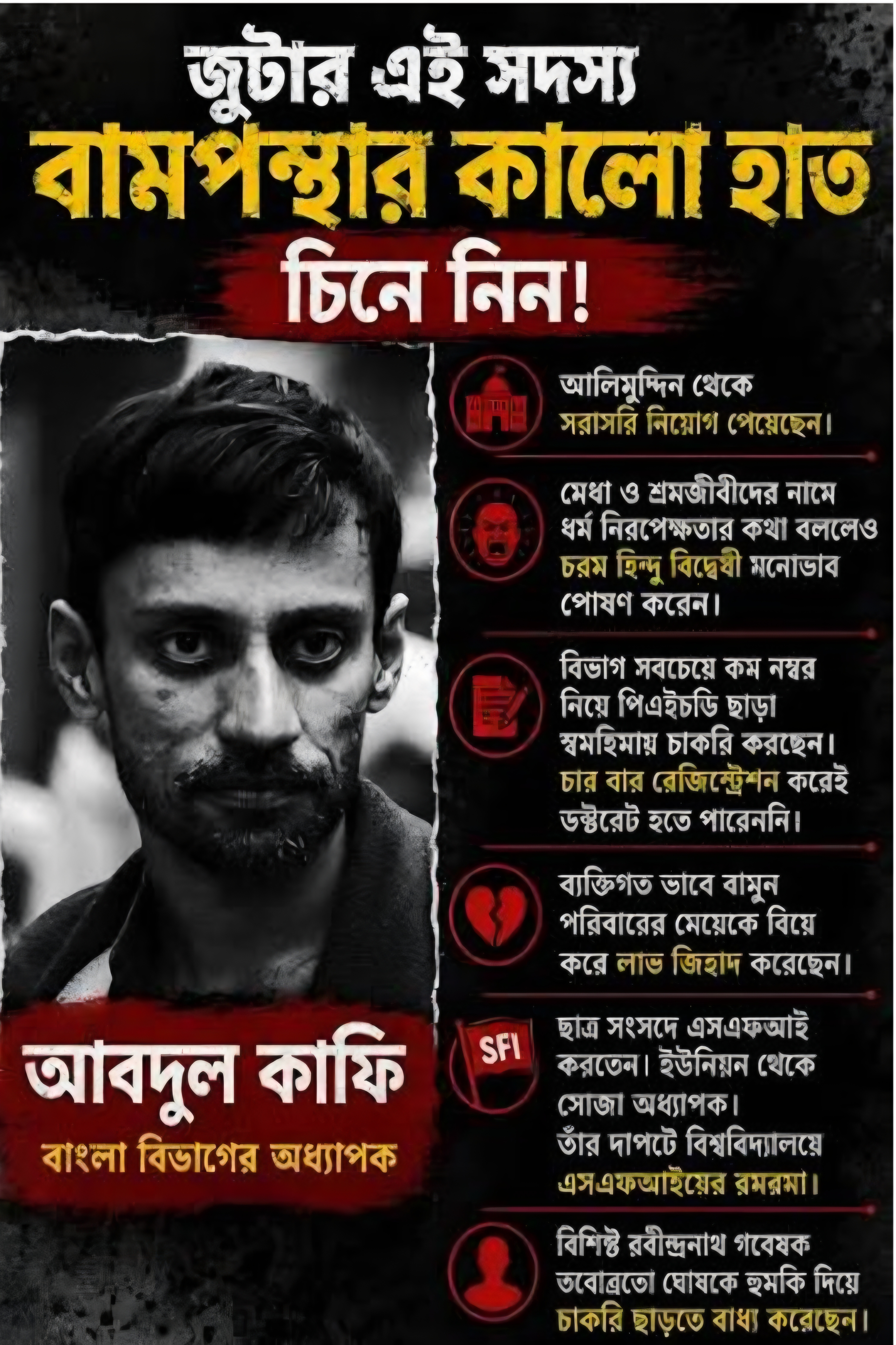
Abstractions like Dimagi Naxal will eventually need a face, and Abdul Kafi, Assistant Professor of Bengali and Head of Centre for Marxian Studies is the designated one. A poster circulated in BJP-affiliated groups puts his photograph under the headline ‘Recognise the black hand of leftism in this JUTA member’ JUTA being the Jadavpur University Teachers' Association, and beneath it lays out a checklist of unverified accusations. He is accused of having been appointed through the direct intervention of ‘Alimuddin, the Kolkata street that houses the CPI(M)'s state headquarters. He is accused of preaching secularism and workers' solidarity while privately harbouring what the poster predictably calls an ‘extreme Hindu-hating mentality,’. He is also accused, in the same flat certainty as the rest, of love jihad for marrying a woman from a hindu Bramhin family. The love jihad accusation, a conspiracy theory that recasts ordinary inter-faith relationships as a coordinated demographic plot by Muslim men against Hindu women that has been propagated by the Hindutva project for decades - converts Professor Kafi’s private life into public evidence of civilisational threat.
At the same time these posters were circulating, a similar incident played out at Surendranath College registered under Calcutta University. Mohammadi Tarannum had taught there for twenty-five years and served as vice-principal since 2007. On September 11 ABVP student groups gheraoed her inside her own office over an attendance dispute for roughly twenty-three hours, with the lights and fans switched off at points and food and water withheld. She signed a resignation letter the students had drafted, and left under police protection. Minutes after she was gone, the ABVP members walked into her office to ‘purify’ it with water from the Ganga and incense sticks. The implications of a hindu nationalist group purifying an academic office previously occupied by a Muslim woman, cannot be missed. It is easy to see why Professor Kafi and Professor Tarannum was targeted. Beneath the BJP’s declared commitment to destroying leftist intellectuals, is their undeclared but barely concealed hatred for everything muslim. The witch-hunting of muslim intellectuals is familiar at this point – Umar Khalid and Sharjeel Imam having served six years of jail without a trial this September.
Dimagi Naxal is the latest addition in a vocabulary that also includes Urban Naxal, tukde tukde gang, and andolanjeevi, attaching itself to leftist student activists with no clear definition of the term. For the BJP, as with the right-wing all over the world through history, the university is where the trouble seems comes from. The trouble is in a mind that thinks, and as a result of it, questions.
Antonio Gramsci states that ruling classes rule through what he calls hegemony - a manufactured common sense so pervasive that domination comes to feel like the natural order of things. Organic intellectuals emerge from and articulate the worldview of a rising class, thus challenging the hegemonic narrative. Gramsci insists that everyone reasons from some implicit worldview – a fragmentary, inherited, often contradictory folklore of a given order that he calls ‘common sense’, that has the ability to develop into a critical understanding that can question those in power, under the refinement and mentorship offered at universities and other learning centres. A hegemonic project has every incentive to keep the folkloric common sense in place and keep its refinement in check. Reading Jadavpur's campus walls, where ABVP graffiti is left standing while Left slogans are erased, as exactly that kind of hegemonic control is not too far a stretch.
Umberto Eco, drawing on his own childhood under Mussolini in How to spot a fascist listed ‘distrust of the intellectual world’ as a defining feature of fascism. For the fascist mind disagreement itself is treason, because independent, critical judgement is corrosive to a politics built on unquestioning loyalty. Fascist movements, Eco argues, are sustained by the conviction that they are besieged by an enemy who is simultaneously dangerously powerful and contemptibly weak, plotting from the shadows of party offices and inter-faith marriages, and yet with enough power to ‘drag the nation down the wrong road’, as Modi claimed in his address.
Gramsci’s analysis suggests that anti-intellectualism is a political strategy for making universities, where counter-hegemonic narratives get built, too stigmatised or too physically unsafe to sustain. The mob that trampled Nandalal Bose's emblem understood, in its own violent shorthand, exactly what Gramsci meant. That hegemony is never secured for good, that the university is where it comes undone, and that the fastest way to stop that unravelling is to attack the root of critical thought.
Sources/References
How to spot a Fascist by Umberto Eco
Prison Notebooks by Antonio Gramsci
ABVP Press Conference: https://www.facebook.com/TheWallBangla/videos/%E0%A6%AF%E0%A6%BE%E0%A6%A6%E0%A6%AC%E0%A6%AA%E0%A7%81%E0%A6%B0-%E0%A6%95%E0%A6%BE%E0%A6%A3%E0%A7%8D%E0%A6%A1%E0%A7%87-abvp-bms-abrsm-%E0%A6%8F%E0%A6%B0-%E0%A6%AF%E0%A7%8C%E0%A6%A5-%E0%A6%AD%E0%A6%BE%E0%A6%AC%E0%A7%87-%E0%A6%B8%E0%A6%BE%E0%A6%82%E0%A6%AC%E0%A6%BE%E0%A6%A6%E0%A6%BF%E0%A6%95-%E0%A6%AC%E0%A7%88%E0%A6%A0%E0%A6%95%E0%A7%87%E0%A6%B0-%E0%A6%A1%E0%A6%BE%E0%A6%95-live/2817286495331221/?mibextid=wwXIfr&rdid=ajwgq0oTaDXXcFJY
Suvendu Adhikari speech: https://www.youtube.com/shorts/HsChN83HLwQ
Jadavpur University incident https://www.altnews.in/jadavpur-university-vandalism-abvp-leaders-bjp-functionaries-identified-in-cctv-footage/
Modi’s speech https://www.facebook.com/thehindu/videos/prime-minister-narendra-modi-in-his-80th-independence-day-speech-said-armed-naxa/1830147727974200/
Muhammadi Tarannum incident: thewire.in/communalism/at-a-kolkata-college-a-muslim-vice-principal-was-forced-to-resign-then-abvp-purified-her-office

