How Gloria Steinem made the invisible impossible to ignore
Gloria Steinem helped transform Second Wave Feminism into a politics of visibility, reproductive autonomy and institutional change. Through feminist journalism and activism, she foregrounded the intersections of patriarchy, race, class and sexuality—making structural inequality both visible and politically contestable.
Making the Invisible Visible, What would bell hooks do? After Black Power, Women’s Liberation, We Have Had Abortions , Women’s Liberation Aims to Free Men Too, What It Would Be Like If Women Win, If Men Could Menstruate, Sisterhood- are just a few among the iconic headlines by the pioneering journalist, activist, author, community organiser, and champion of women’s rights, the late Gloria Steinem, who was positively instrumental in shaping the initial trajectory of the Second Wave Feminism in the United States of America during the late 1960s. Born on 25th March, 1934, Steinem grew up in a family where her parents separated when she was just ten, and soon her mother suffered from a debilitating mental breakdown. Growing up in a run down establishment in Toledo, Ohio, she witnessed the suffering of the working class people and that shaped her outlook of life quite early on. Despite the setbacks life threw her way, she completed her education.
Having completed her graduation, Steinem travelled to India for two years. Since the Gandhian mode of non violent dissent was aptly suited for women’s movement all across the world, she approached Kamaladevi Chattopadhyay, an Indian Freedom fighter and cultural icon, with the help of her oldest friend in India Devaki Jain. The interaction with Kamaladevi Chattopadhyay regarding Gandhi’s methods of non violence and trying to build resistance from within intrigued Steinem. She recollects in her essay Doing Sixty, which is part of her book Moving Beyond Words (1995) how Chattopadhyay commented after listening to her and remarked 'of course Gandhi’s tactics were suited to women — that’s where he learned them.' Her stay in India left an indelible impression in her psyche. It is reflected later on in the conceptualisation that manifested in the cover page of the debut edition of the women’s magazine Ms., a brain child of Gloria Steinem and her passionate compatriots in the women’s liberation movement. The cover features a woman with blue skin, multiple hands, a womb carrying a baby, and tears running down her eyes, aptly projecting the hapless plight of multiple women stuck in the quagmire of social stereotypes across the wide world. This was inspired from the image of the goddess Kali.
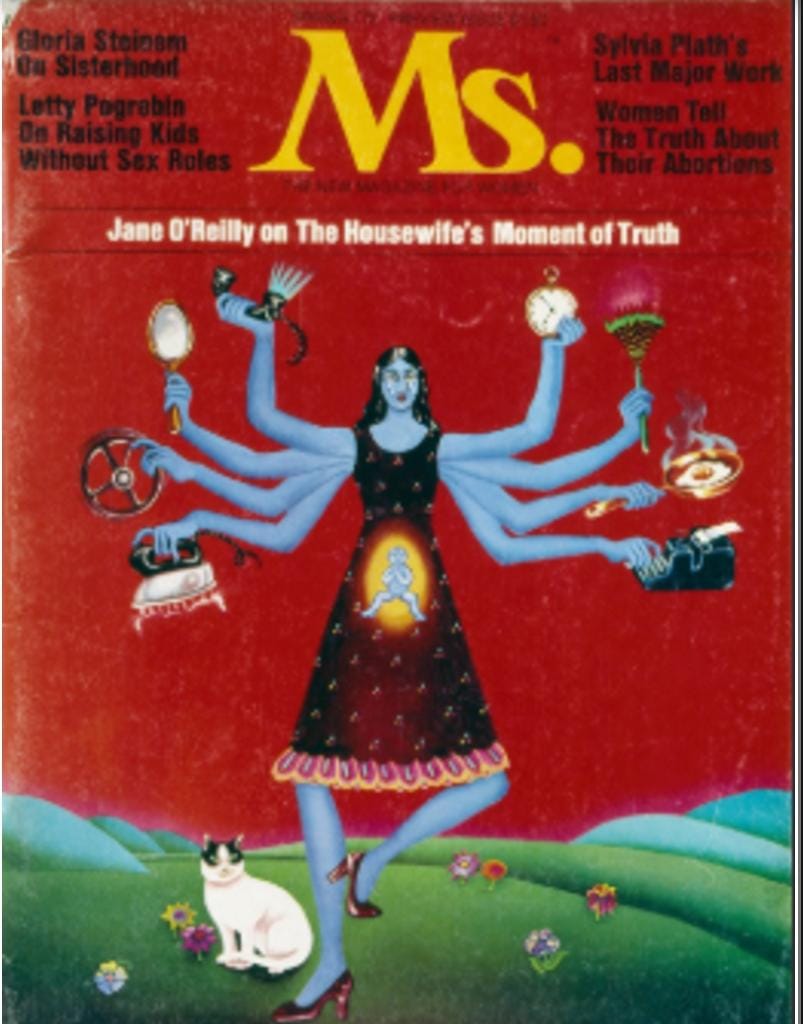
However, on returning to the U.S., she took up the role of the director of the Independent research Service, a CIA funded group that organised and recruited young Americans to disrupt the Soviet backed World Youth Festivals in Vienna and Helsinki. It operated as a counter cultural movement to challenge the influence of the Soviet. Later on, Steinem did not deny her active association with the CIA and remarked that if given a choice, she would do it again.
Although she garnered accolades for her infamous two-part writing which exposed the abject exploitation of the glamour models working in Hugh Hefner’s Playboy Club (where she had gone undercover as a Playboy Bunny herself), there have been many more milestones that establish her as a trailblazer. A particular moment in a church basement in Greenwich in 1968 went on to become what she calls her feminist click moment, where women had gathered for an abortion speakout
In 1971, Steinem formed an alliance with Dorothy Pitman Hughes, American advocate and activist and spoke on the importance of diverse women’s experiences. She believed that if it was all white, it was not feminism.
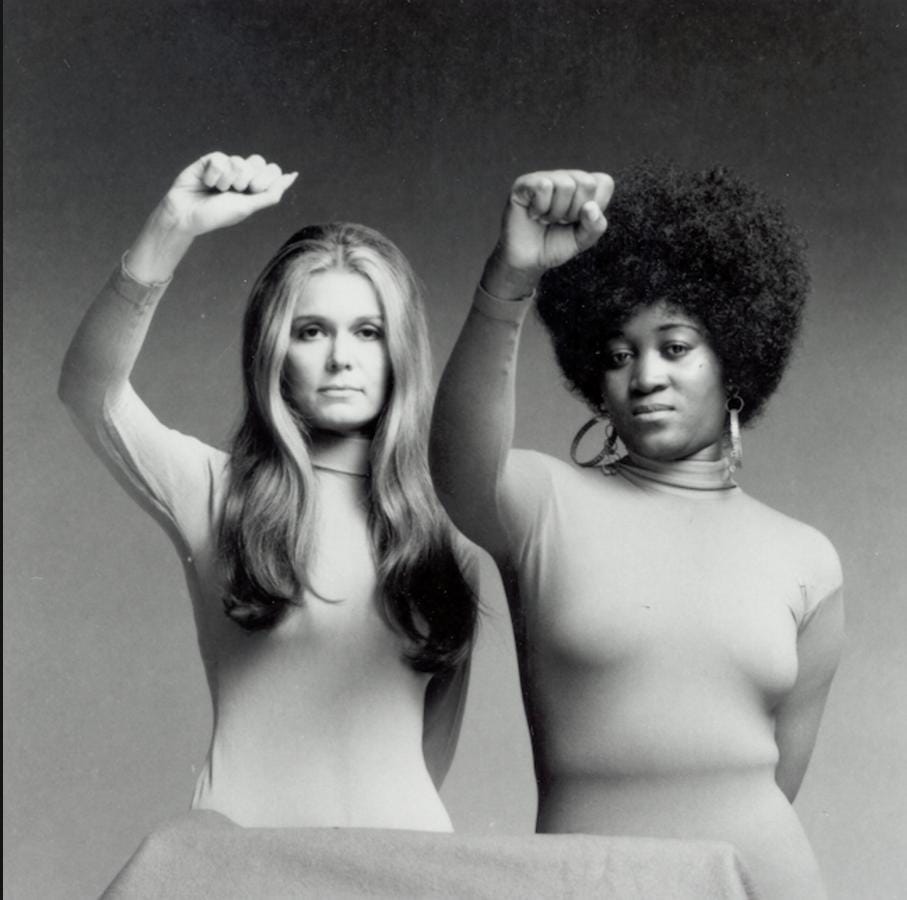
The same year also witnessed the foundation of The National Women’s Political Caucus with Gloria Steinem, Shirley Chisholm, Fannie Lou Hamer at the helm. The year also saw Gloria Steinem co-founding the revolutionary women’s magazine Ms. with Letty Cottin Pogrebin and Robin Morgan. This was perhaps the first public forum which openly spoke about women’s reproductive rights openly at a time when it was illegal in the US. She spoke about the politics of gender and sexuality as political tools aimed at oppressing both men and women. At a time which predates the internet or social media Ms. created a platform where women felt visible, heard, and it created what Steinem called A Portable Friend. It gave serious work to women and a platform for the expression of their truest selves.
Steinem was an active part of the historic National Women’s Conference at Houston in 1977, where about 20,000 women gathered to discuss abortion, lesbian rights, racism, disability, violence, labour, and political representation. She declared it as the most important event nobody knows about.
Steinem operated on the agenda of gravitating towards institutional change not just empty words, but ones that would be translated into practice, bringing about justice, dignity and becoming a part of the lived reality. Steinem asserted that if we cannot name a thing, we cannot speak up against it, so it was absolutely imperative to identify the problem, only then would the quest for the solution become a real possibility. She coined the terms reproductive rights, battered wife syndrome, and ideas surrounding subjects like sexual violence and pornography. It is interesting to note that her and her sisters’ battles against patriarchy were not lost in vain. In 1973, a landmark U.S. Supreme Court decision protected a pregnant individual’s right to choose an abortion before fetal viability (Roe v. Wade case). However, it was overturned in 2022. Multiple welfare centers opened in the U.S. to provide refuge to troubled women after the stories done by Ms. In 1980, the Equal Employment Opportunity Commission added sexual harassment as a form of sex discrimination. In 1994, the Violence Against Women Act was passed.
The granddaughter of a Suffragist, Gloria Steinem’s perpetuating legacy lies in her capacity of listening and paying attention to the detail and finally relaying it. Steinem took part in the Women’s March in 2017, was a part of the #MeToo movement, as well as the #BlackLivesMatter movement. She was a staunch critic of Donald Trump and inspired generations of women to identify their true worth. Although accused of appropriating the voices of colored women, she dedicated her life to actively advocating for women of colour. She spoke up against injustice till her last days. Steinem successfully mapped the contours of intersectionality quite early on in her career and identified that the crusade for justice is not a singular strand but intertwined across multiple identities and bound firmly by distinct cultures and histories.


