Part 2- Can we turn a killing machine into a caring one?
Part 1 examined the crisis within India’s premier science institutions, questioning a system that blames individual 'coping mechanisms' while leaving its structural failures untouched. It traced how meritocracy and Brahminical hegemonic ideas of scientific knowledge operate within a neoliberal capitalist order, warning that the 'killing system' could become the norm. It ended on a grim, almost dystopian note. What followed at IISER-Pune was different: students turned trauma into resistance, demanding mental-health infrastructure, freedom of movement, student spaces, protection from retaliation and institutional accountability.
Students protest for a repaired future
What A Week’s Sit-in Protest Can Teach Us?
Even though the last article ended with a grim undertone, not very far from a dystopia, the following week at IISER-Pune saw something very different.
The unresolved trauma stemming from the series of student suicides across these campuses and the authority’s continuing apathy, turned and solidified into a sit-in protest organized predominantly by the BS-MS students of IISER-Pune. They started gathering in front of the admin building to demand accountability from the authority on various high-stake issues, including the demand for reinstatement of a former elected Student Council (SC) member and 3rd year BS-MS student Raj Bagwe, who was suspended last semester. When I started this write-up, the sit-in had already entered its 3rd day on Saturday, August 29, 2026. Late night, on September 2, the students called off the sit-in after most of their demands were promised to be accepted by the authority.
Before getting into a more detailed discussion, let us first hear some words directly from the sit-in. The following interview was taken on August 28, by a friend studying at IISER Pune, with another demonstrating student. Both of them chose anonymity.
“We Cannot Breathe Here Anymore”
Why are you here? Why is the revocation of Raj’s suspension so important in the demand list?
I am here because of the systemic failure of our institute in every aspect. It’s such a claustrophobic system that we can’t breathe here. I am not personally that close to Raj, but I could imagine what Raj’s been going through for the last couple of months, being suspended without having given any proper reason. How could you just form a committee by yourself, with an ineffective student representative, while dealing with a case involving a student? How could just repeating the phrase 'everything is confidential' justify your action, particularly when a student’s career is at stake? I know the inside stories of students becoming puppets to the authority and getting away with assault cases against them. Raj raised his voice against you on right points; that’s why he has been punished, right? If I do not say anything now, you can anyway suspend me in the near future for no reasons. So, why not say something?
What is the status of the protest now? How many people are participating in the protest? What are your other friends’ take on it?
On August 27, we started the sit-in around 11:30 am. After that, we went to the Baner gate outside to do some protest demonstrations and then came back to the main building. We were sitting there for the whole day and night. A constant mass of almost 100 folks were there, with really funny but incisive posters.
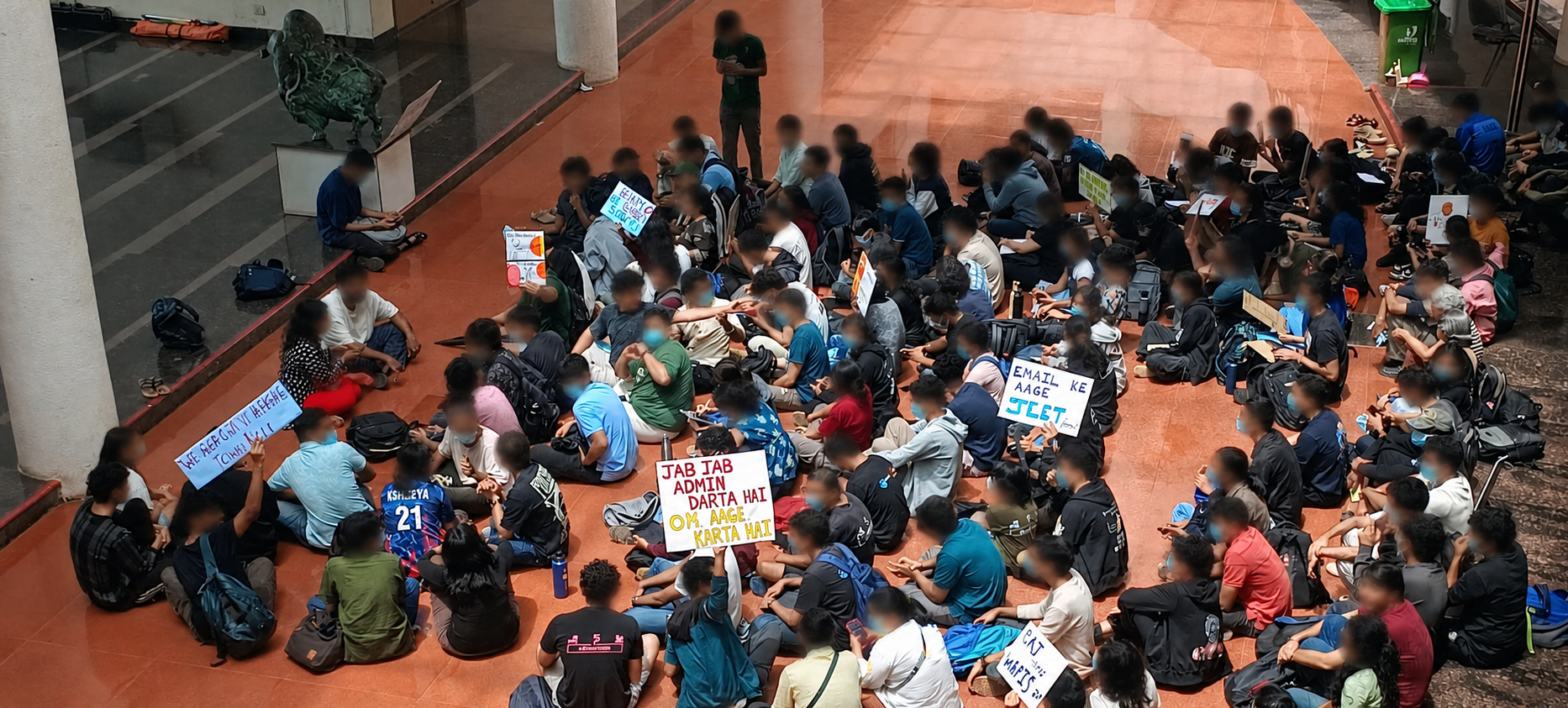
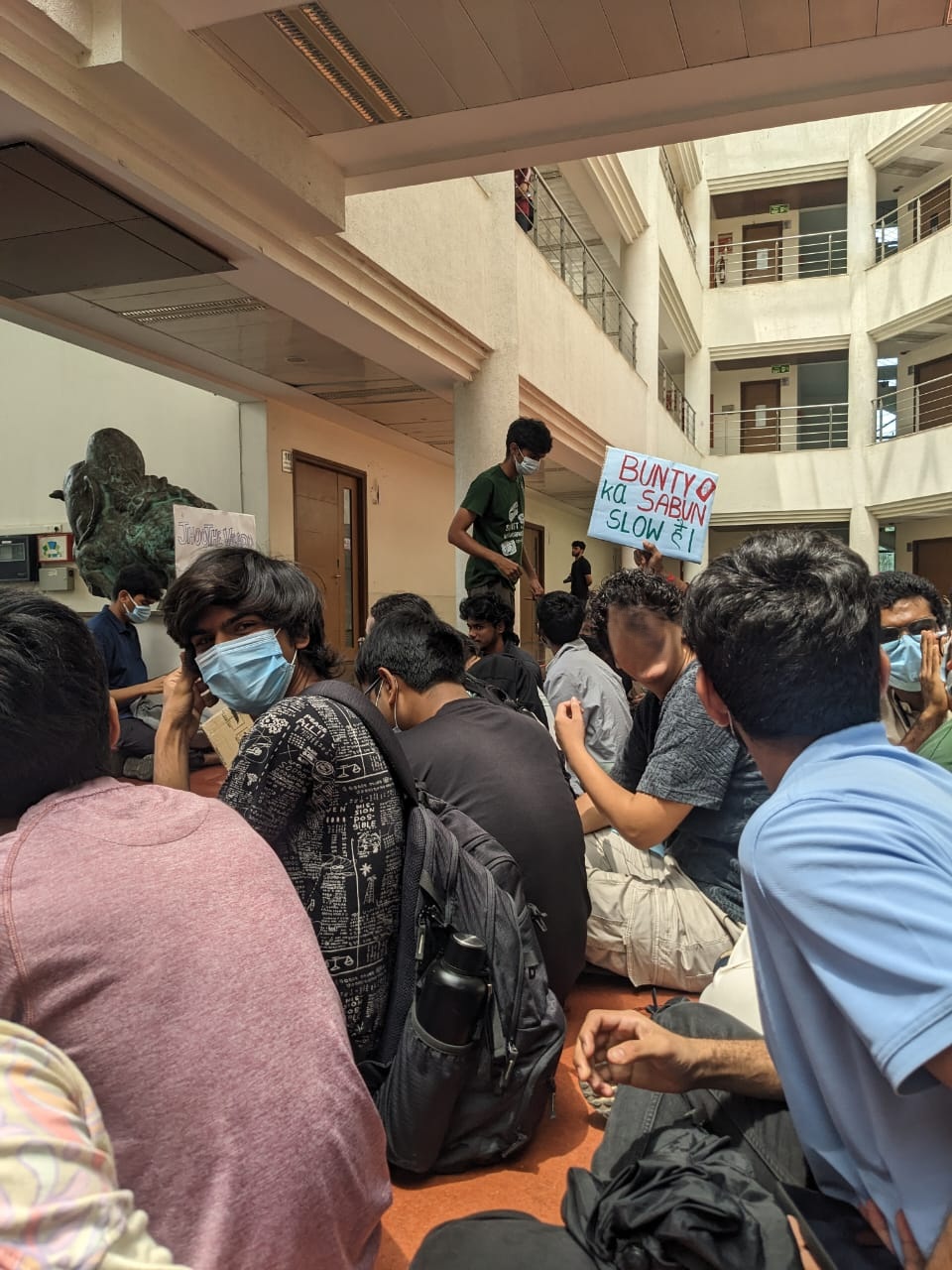
Fig. 1 and Fig. 2 (Students at the sit-in, with posters)
Late at night, students took turns to sleep on the floor. We want to see it to the end. We are here in a peaceful sit-in demonstration. We want to see how much they could ignore us. We are here alternatively, attending classes in turns. We are carrying our books with us and reading while in the sit-in. Constant discussions on many things are going on. We also have our friends, who are not physically present here at the moment, just a phone call away to instantly join us if need be.
I saw political student organizations coming in solidarity. What is your take on it?
It is our protest; we, the general students, are handling it. If someone wants to come and show solidarity, they can. But it is our cause. No organization can put their agendas on top of ours. I could feel that the general students prefer not to stand under any specific political banner. The reason could possibly be the political baggage and regimentation of such organizations.
What is your take on surveillance inside the institute?
Some days ago they started putting CCTV cameras in the hostel corridors too. Some of the CCTV cameras are directed to the insides of our rooms. See, privacy is my constitutional right! 'Mere pas chupane ke liye kuch hain nehi, iska matlab thori hain ki tum CCTV lagake woh check karoge for confirmation?' There was this incident once, when a recorded CCTV footage was really needed for locating some lost item. We were categorically dictated by the admins that they won’t show the footage for such a purpose. It proved that the sole purpose of CCTVs in the campus is surveillance, not our safety. You literally are thinking of us as criminals.
What are your thoughts on the mass concern about the mental health issues on the campus?
Folks do have mental health issues. We have to deal with it as a community. Depression, stress, and anxiety are daily things for us. Literally anyone caring enough, an admin folk, a professor, or even a senior PhD student could be a counsellor. We are so fed up with the admins’ behaviour that we are not even asking for a wholesome caring environment. For the time being, it is just a demand for more counselors who would at least listen to us for an hour.
UGC guidelines anyway mandate 1 counselor per 500 students. But we have only 2 counselors for a student strength of 2000. It takes a minimum of 2 months to just get an appointment.
What is your take on the blanket ban on cross hostel mobility?
I know there have been some gender related security tensions noted by some hostelites in the B wing of hostel 2. But see, if someone deliberately wants to breach the personal space of others, they would do it anywhere in the campus. The solution is gender sensitization and raising awareness about personal space. Why are you putting a cross-hostel mobility ban? We are not even asking for BS-MS cross hostel mobility, because technically there are still some under-18 students. But PhD folks are adult folks! Some of them are even married couples. How could a public institution ban someone from meeting their partner if their partner is from a different gender? That’s draconian.
Draconian Admin
'Why is the admin imposing draconian rules on students and treating us as puppets without agency' was the beginning sentence of a poster which the IISER-Pune walls across the campus saw pasted on them, on the evening of August 25. The poster called for a peaceful sit-in protest to start from the morning of August 27.
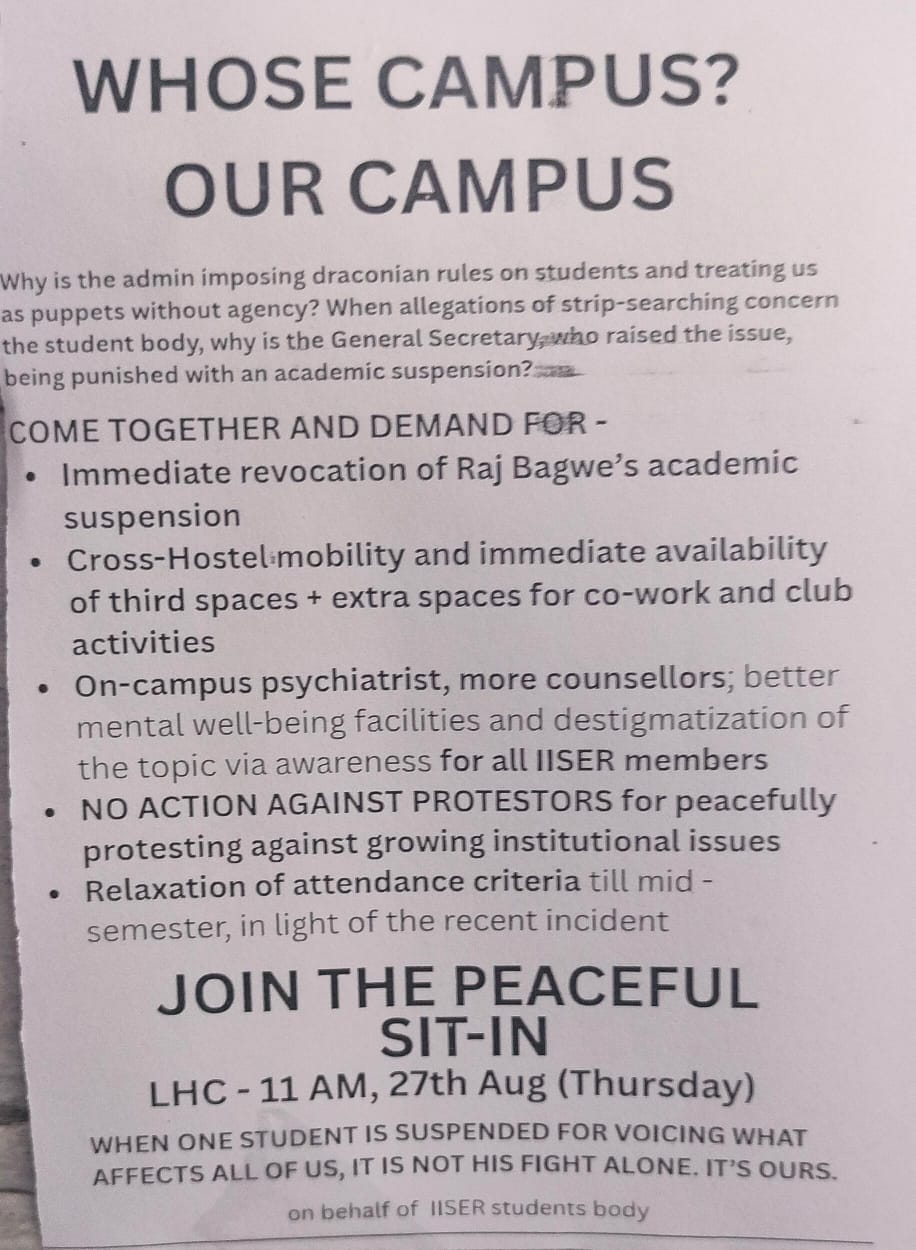
Fig. 3 (The first poster about
the sit-in)
Raj’s incident
The IISER-Pune administration, among other such premier institute admins in the IITs-IISERs-IISc network, is particularly infamous for curbing voices and free speech by taking punitive actions against students raising such concerns. This attitude has been in a sharp incline after BJP came to the central power in India. Raj Bagwe, a 3rd year BS-MS student and one of the democratically elected members of the student statutory body Student Council (SC), was suspended, with hostel accommodation and scholarships revoked last semester. It happened when Raj, the general secretary of the SC, became vocal pointing out serious concerns regarding institutional conduct toward students. On one of the exam days, the security personnel almost strip-searched female students who wore hoodies to the exam hall. Several sources inside the IISER-Pune campus confirmed that wearing hoodies across the year is nothing uncommon. Raj, with institutional access to mass-emailing that comes by default with his elected position, flagged this severe breach of personal space to the whole IISER-Pune community via an email. It triggered the admins so much so that they formed an investigation committee, culminating in suspending Raj on the basis of him breaching the IT policies of the institute. Enraged students gathered for the sit-in unanimously opined that Raj was doing exactly what he was elected to do. Raj’s reinstatement in full capacity makes the first among the 6-fold demand-list that they had drafted. However, it is also the demand the authorities did not accept. Students have rewinded for the time being but assured near-future interventions on it, against the IISER-Pune authority.
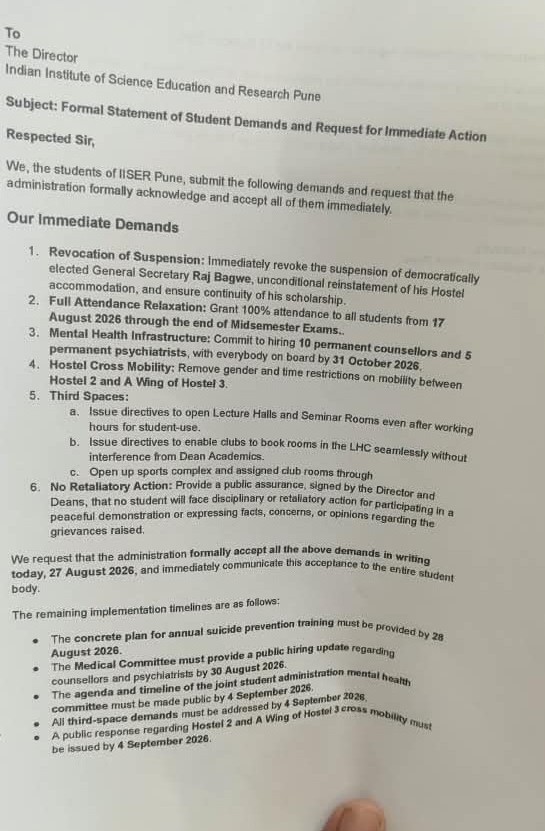
( Fig 4 and 5: the demands enlisted)
The mechanism of disciplinary power
As famously described by philosopher Michel Foucault, the power that the institutional authorities assert on its subjects (in this case, the students) are rarely physical with a traceable source, thereby making it very difficult to hold individuals accountable. According to him, such power, 'instead of emitting the signs of its potency, instead of imposing its mark on its subjects, holds them in a mechanism of objectification' (1977, p. 187) [4]. Foucault termed this type of power as disciplinary power, where particular disciplinary or knowledge-based norms justifies the assertion on its subjects. As we hinted in the previous part of this report, almost all the individuals holding administrative positions are assumed as qualified solely in reference to their respective degrees earned, degrees that were conferred to them by top-most institutes across the world like the OxBridge, Harvard, or the premier ones in India. That is why the admins in such institutions can still behave in a way which, when put in comparison with the general norms, ethics, and morals of a democratic and sensible society, seem utterly illogical and inhuman. Institutions thus become a perpetual state of exception, as hinted at in my first article [1]. Almost like cunning lawyers, they employ word-plays to set up default potholes in the running discourses or email exchanges with students. Enraged students more often than not fall for this trap and are bashed with punitive administrative actions taken against them. Raj’s incident was a vivid evidence to that.
However, this time, the students retained their calmness and proceeded with intense caution. They could foresee the rigged game and responded accordingly. I invite the readers to walk with me through a detailed timeline of a dramatic exchange that ensued between the protesting students and the authority at IISER-Pune after the sit-in started on August 27. In the takeaway sections following each unit, I delineate the intricate ways disciplinary power works and how students could disrupt them.
Around 4 pm, August 27, 2026
Two faculty members reached out to the students at the sit-in, conveying Dean SCA’s (Dean of Students and Campus Activities) request for a formal submission of demands through SC. Dean SCA apparently proposed a closed-door meeting between representatives from the demonstration, the SC and the Deans of Student Activities. Students rejected the proposal of a closed door meeting on two clear bases: SC does not represent the whole of the demonstrating mass, and closed-door meetings are not in ethos with the sit-in. Students have a long and firsthand experience of their emails regarding student-concerns being ignored. Their logical deduction, in light of the conflicts of interests between the stakeholder parties, was an imperative that the Dean accept the letter of demands in-person and communicate with the demonstrating students. Moreover, the students agreed and proposed a delegation team that will talk to the Dean in an open-door meeting with recording made available.
Following this, the Chief Security Officer (CSO) said that a delegation of faculty/Deans might come to the demonstration site, within 15-20 mins. An hour from that, it was informed that nobody was coming to meet the students.
Takeaway: The constant effort from the admin’s part to keep the demonstrating student-mass as divided as possible by subjecting the students to specific structures and categories created by the admins themselves— SC, demonstrating students, sit-in students etc. Dilly-dallying in accepting easily implementable exchange modes for proper accountability. Stressing on closed-door unrecorded meetings and negotiations with fractions of students.
6:17 pm, August 27, 2026
Dean SCA sent an email requesting the demand-list be sent formally via email. Demonstrators were apprehensive about possible retaliatory actions taken against them, since a student will have to send the email and thereby hold a digital footprint in the server (Raj’s case in the past). It was conveyed to the CSO that there has to be a clear and written assurance of no retaliation from the part of the admins, and only after that the demands will be sent formally via email.
Shortly after this, Dean SCA sent an email saying 'if the letter is written and signed by students, just for writing the letter with demands there is no punishment'. Students unanimously decided that the wording is still vague and the email should come with specific mentions of immunity for every student taking part in the peaceful sit-in and associated peaceful communications and activities. In reply to this, the Dean indicated that such a response was not under their authority. The conversation thus hit a deadlock.
Takeaway: The word-plays employed by the authority, where, through non-mentioning and vague wording, retaliatory actions against students still remain lurking as a possibility. Also, the students showed immense maturity in sensing the rigged game.
Around 7 pm, August 27, 2026
Some faculty addressed the sit-in in personal capacities, in an attempt to open up a channel of communications between demonstrators and admins. They categorically made it clear that they were not present in any official representative capacity. Students again openly voiced their demands and apprehensions about retaliatory actions for email exchanges. They stressed on their distrust in verbal promises from the admins, citing past examples. Later, some of the faculty members informed the students that the demands have been relayed to the whole faculty, Deans and Director.
Takeaway: Faculty members, some of whom also hold designated administrative positions, did not take any official responsibility for peaceful and meaningful conversations on record. Students’ unity and their logically grounded reasonable voices forced the faculty to at least take the ball to the admin’s court.
5:27 pm, August 28, 2026
After almost a day, the director sent an email. One of the sentences verbatim in that email was, 'The institute will not initiate disciplinary action against all IISER-Pune students participating in or organizing the current peaceful campus sit-in', literally carrying the meaning that some IISER-Pune students participating in the sit-in can still be persecuted institutionally. The email also had mentions of vague words like unlawful acts and applicable laws. Students caught those red-handed and clearly communicated with the CSO around 7pm that there has to be a written promise of blanket immunity and specific official references regarding what 'unlawful acts' and 'applicable laws' mean.
Takeaway: The same word-plays and the students’ perfect detection. Check the vague use of legal terms in the email.
2:48 pm, August 29, 2026
After almost a whole day passed with no responses from the CSO, a student had to come forward and send an email expressing the need of clarification, in reply to the Director’s email from August 28.
4:42 pm, August 29, 2026
The Dean SCA, on behalf of the Director, sent a clarificatory email. It was mentioned that the sentence under concern in the Director’s email is to be read as 'The immunity is applicable to any IISER Pune student participating in the peaceful sit-in'. It was also mentioned that the usage of the words ‘unlawful’ and ‘applicable laws’ in the Director’s email was as per the institutional O.M.’s (official mandates) and the Constitution of India. Students then formally replied to the Director’s email acknowledging receipt and mentioned that the full demand with signatures from all the consenting students will be sent.
Takeaway: Had there been no critical consciousness about how the official authority discourse runs and sustains itself inside such campuses, many students would have been persecuted by now, merely for replying to authority emails, or drafting demands for just causes, or coming to the peaceful sit-in. Words and discourses become immensely powerful just by the meaning and norms they operate under. It has been the admins running those discourses and controlling the meanings by deliberately being vague in their emails and with their stances. Admins also control the technology behind the institutional emailing system. Justification for such control came from the unstated yet oft-practiced and re-produced norms like educational degrees make people competent in all other affairs, or, degree-wallas/merit-wallas will be the only arbitrators of understanding what is good or bad for the students. I am not saying that the students read Foucault to understand how discourse and power are always already entangled with disciplinary knowledge. But through their prior institutional experiences, a sense of unity as a community, and standing for mutually aiding each other, pushed them to respond to that puzzle to some extent.
The Director’s email and the subsequent clarifications literally proved the point that the authority has been malpracticing their administrative power to obfuscate their own incompetence and lack of any institutional ethics, let alone being minimally caring towards the students. It also points to the fact that such punitive actions from the part of the authority in such a network of institutes are not standalone deviations, rather are norms. Students brilliantly foresaw it. That is the reason why they had No Retaliatory Action against peacefully protesting students pre-emptively added as one of the demands in their draft.
Among the other demands, notable was the one on the need of a robust mental health infrastructure. Students demanded having a permanent hired body of at least 6 counsellors and 3 psychiatrists on the campus, with proper accessibility setups ensured from the authority’s part by 31st of October, 2026. This demand particularly relates to the recent death of the student and the publicly re-surfaced lack in the institute’s existing mental health support system.
The demand list also included the lift-off of the rules barring cross-hostel mobilities and the need of ‘third spaces’ in the campus. We are clubbing these other demands together in the separate section below, for the sheer potential they hold for a repaired future of science research and education in India.
Third Space
Spaces, no matter their types, are a fundamentally integral part of our lives. As far as our commonsense goes, spaces are the physical entities we inhabit. Adding some critical introspection to it, we could say that the spaces are not random. They carry purposes (a classroom is for delivering lectures), ideologies (zoning out a section of a city for the homeless dwellers so that the poverty is not visible at a general scale thereby not hampering corporate investments etc.), or values/biases (that part of the city is for Muslims/Blacks and therefore worth avoiding during nights). But, do the spaces live in us?
According to critical urban theorist Edward Soja [5], the last question is answerable positively. Spaces do live in us in that no matter the physical type of the space, or its purpose, or the ideological, value-based designs of them, it is ultimately us, who by living, remembering, and resisting, give deeper meanings to the spaces. If we call the physicality of a space Firstspace, the ideological underpinnings of a space the Secondspace, our evolving co-existence with spaces is captured by the concept of a Thirdspace. Soja borrowed and developed these ideas from famous French urban theorist and philosopher Henri Lefebvre, whose theories have become more urgent than ever for our urban lives and spaces in late capitalism [6].
I think it was such a conception that the students aspired for, when they listed the need of Thirdspaces. Soja stressed particularly on how no matter the restrictions put by the physicality or the ideological substances of a space, people inhabiting spaces always carry the potential to go beyond those restrictions, thereby making any space a Thirdspace. IISER-Pune like premier science research and education institutes is constructed borrowing Western colonial models of design with immense stress on utility, compromising multiple and diverse ways of conceptualizing educational spaces [7, 8]. No part of the IISER-Pune campus is constructed with a purpose of, say, students gathering for sit-in protests. Though not spelled out, when the students focused on the word Thirdspace, we cannot deny the possibility that they aspired more than what the physical and utilitarian spaces of the campus had to offer. It is true that in their definition of a Thirdspace they settled with physical and technical demands like keeping the lecture and seminar rooms open after official hours for student-use and allowing students to book clubrooms without Dean Academic’s intervention. But they nonetheless made us re-think and critically dissect the embedded space-norms of the institute.
Aspiration for a Thirdspace was not limited to just one point in the students’ demand list. When they demanded a committed ‘mental health infrastructure’ we could not help wondering about the usage of an architectural word like ‘infrastructure’. Such usage was actually a community resistance against such inhuman norms of the institute that led to installing iron grills on the hostel corridors lest the students do not jump off of them. Students on the other hand, were geared towards a more caring space-intervention, like having easily accessible mental health counselors in enough numbers, and a caring community as a whole. The institute could not understand the grammar and the pains embedded in the students’ language.
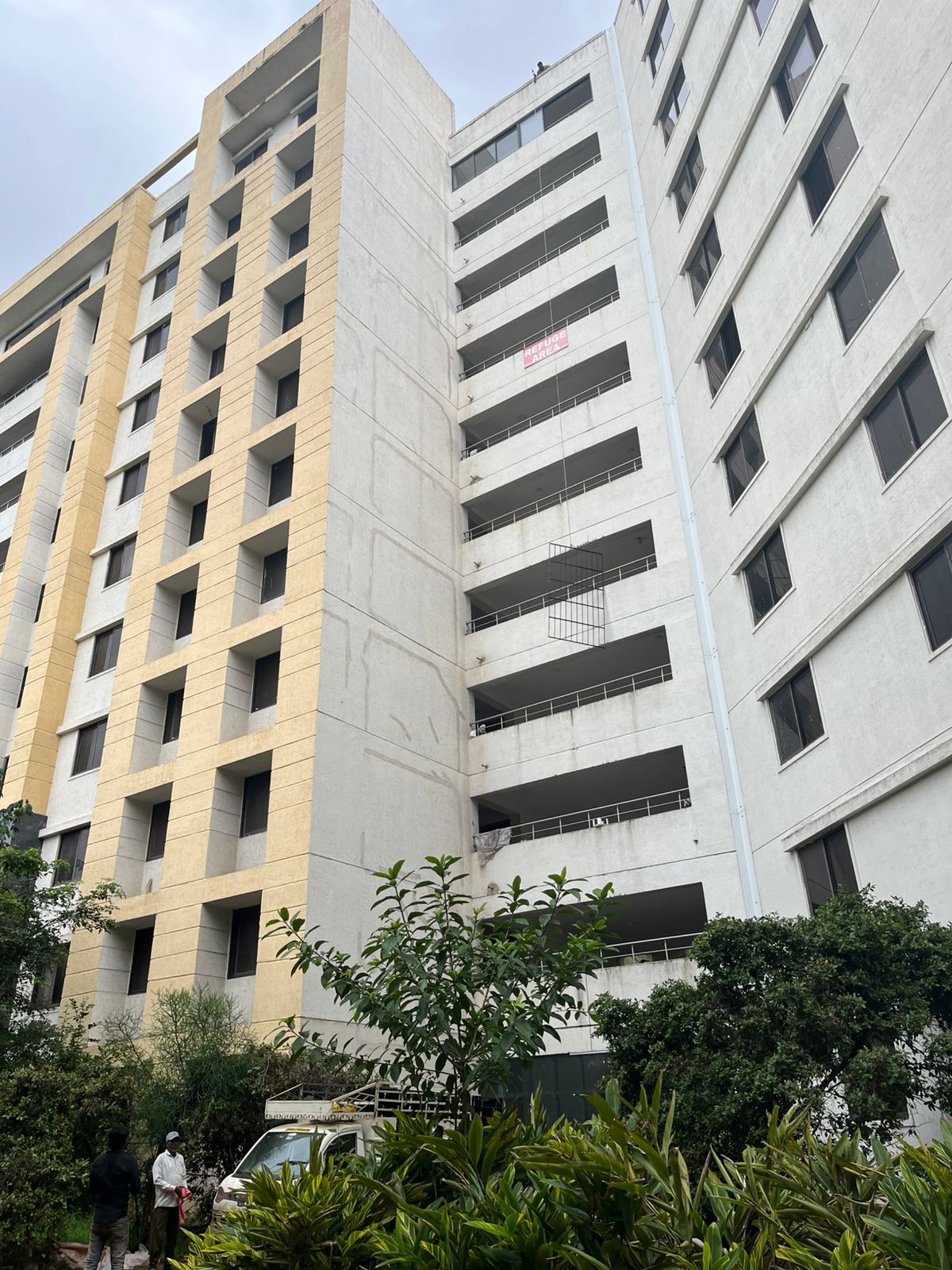
Fig. 6 (Authority responding to student suicides with an iron grill)
Thirdspaces allow inhabitants to struggle and live with contradictions and nuances, something premier scientific institutes generally discourage in India. Students at IISER-Pune are always-already and evidently in that process, no matter how well they could substantiate that. The following example rather proves it on their behalf. This example will also give the readers a context of their demand on revoking the cross-hostel mobility restrictions.
Last month, IISER-Pune admins suddenly imposed a blanket restriction on mobility between the men’s and the women’s hostels, under the pretext of women’s safety, citing some complaints from the women’s hostel about male friends visiting. When the students gathered in the IISER-Pune townhall to have a general body meeting on this matter, a female student from a minority community, who by personal choice wears a scarf whenever stepping outside her private space, stood up and shared her experience. She once had felt, indeed, very uncomfortable, when a male friend suddenly appeared in the women’s hostel corridor while she was without her scarf. When subsequently asked for opinion on how to avoid such situations, and whether the new restriction should be implemented on the basis of such lived experiences, she however replied with a straightforward No. She acknowledged the complexity without falling for a binary trap. To quote her verbatim,
“Many of my friends and seniors in my floor already know about this. If they simply let me know beforehand while inviting a male friend to their room, I can prepare myself in advance. Solutions like this exist. A blanket ban is not the solution. We must not forget that everyone here is a friend or a senior to one another. We should always try to solve our problems organically, instead of involving authority every single time.”
Apart from these anecdotes, science learning and research are anyway deeply community dependent no matter how the normative view of ‘science practitioners working alone in a secluded laboratory’ paints it colloquially. Bruno Latour and Steve Woolgar’s work stands as an example to that [9]. Objectivity and deep self-reflexive pursuits of knowledge, the so-called bearings of science as a discipline, do not stand in opposition with a community with diverse orientations, as long as the community has a certain basis/criteria of mutually agreed and evolving norms. Hence the need for a Thirdspace, such strongly expressed by the IISER-Pune students, must be listened to as a serious call for support by the wider science education and research community, not only for the sake of maintaining basic constitutional rights, but also for a sustaining future generation of science practitioners.
In response to the famous philosopher of science Helena Sheehan’s most recent caution against the 'milieu of no respect for norms of logic, evidence, coherence, justice, and so on' [10], IISER-Pune’s students are momentarily offering some solid scientific ground to stand on. Deep care for each other and for mutual wellbeing among science practitioners and students, when taken as non-negotiables, can indeed give us a criteria in an otherwise no criteria posttruth society. It can lead to sustaining the dream for socialism, with science practitioners contributing to the vitality of creation [10].
Science can truly be for the people, one day.
Reference
1. https://inscriptenglish.me/iiser-pune-student-death-campus-silence-institutional-failure
2. Thomas, R. (2020). Brahmins as scientists and science as Brahmins’ calling: Caste in an Indian scientific research institute. Public Understanding of Science, 29(3), 306-318. https://journals.sagepub.com/doi/abs/10.1177/0963662520903690.
4. Foucault, M. (1977/1995). Discipline And Punish: The Birth of the Prison. New York: Vintage Books.
5. Soja, E. W. (1996). Thirdspace: Journeys to Los Angeles and Other Real-and-Imagined Places. Oxford: Blackwell.
6. Lefebvre, H. (1991). The Production of Space (trans. D. Nicholson-Smith). Oxford: Blackwell.
7.https://shinde.co/the-paradox-of-postcolonial-indian-architecture.
8.Dutta, A. (2007). The Bureaucracy of Beauty: Design in the Age of its Global Reproducibility. New York: Routledge.
9.Latour, B. & Woolgar, S. (1986). Laboratory Life: The Construction of Scientific Facts. NJ: Princeton University Press.
10.https://monthlyreview.org/articles/capitalism-and-cognition/.

