What does it mean to be non-binary? Why does society find it so difficult to accept?
Neha Bora: What does it mean to be non-binary in a society still governed by rigid ideas of gender? Through the hostility faced by student leader Neha Bora, this article explores the intersections of gender identity, class, caste, political solidarity and the limits of equality.
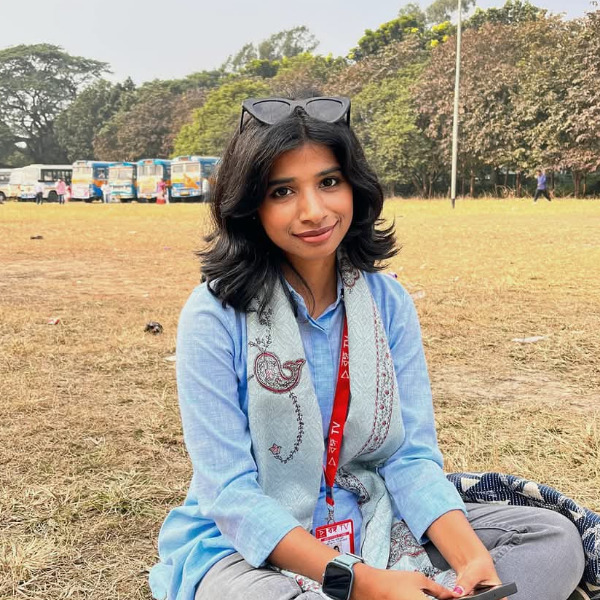
Neha Bora announces their non-binary identity and asks to be addressed using they/them pronouns.
Neha Bora, President of the All India Students' Association (AISA), announces that they identify as a non-binary individual. This incident has opened a Pandora's box of hatred and trolling once again and brought an uncomfortable question into public discourse: what exactly is it about another person's gender identity that makes so many people feel entitled to intervene, ridicule, police or even threaten their existence? Neha's insistence on being addressed by they/them pronouns has invited the familiar assortment of online abuse, misogyny, transphobia and moral policing. Unsurprisingly, much of this hostility comes from the BJP-RSS ecosystem and particularly from its majoritarian imagination of an idealised Indian society. However, it would be intellectually dishonest to locate the entire problem in the organised right-wing nexus. What makes this moment particularly significant is that the hostility directed at Neha is unfolding alongside a legislative narrowing of who is entitled to be recognised as transgender in the first place.
Gender diversity has never been an unfamiliar territory for India. Our literary, cultural and historical references contain several accounts of bodies, identities and social roles that complicate the neat division of humanity into two supposedly immutable categories. Yet there is a difference between remembering gender diversity as a part of our cultural inheritance and accepting gender-diverse people as equal participants in contemporary society. We seem comfortable with the former, particularly when it can be romanticised, mythologised or appropriated as evidence of an exceptionally tolerant civilisation. The latter, however, demands a redistribution of social legitimacy, agency and power, and that is where the discomfort begins. Historical plurality did not necessarily mean historical equality. Nor can the existence of gender-diverse figures in our cultural imagination be used to suggest that contemporary trans and queer people have somehow inherited a society free of discrimination.
This contradiction is particularly visible in the Transgender Persons (Protection of Rights) Amendment Act, 2026. The amendment significantly narrows the definition of who qualifies as a transgender person under the law. The amended definition removes multiple categories under the trans umbrella and excludes people with self-perceived gender identities, retaining specified socio-cultural identities, certain intersex variations and people compelled to assume a transgender identity. It also introduces a medical board into the certification process, shifting the authority to recognise an identity away from the individual and towards medical and administrative institutions.
The implications are substantial. Trans men and many non-binary and genderqueer communities, particularly those who do not belong to the specified socio-cultural categories, are excluded from the statutory definition. This is not merely a question of terminology. The Act's anti-discrimination provisions and its associated entitlements are tied to its definition of a transgender person. Those excluded therefore risk losing access to the specific protections and recognition mechanisms available under this legislation. This does not mean that every constitutional or other legal protection ceases to exist, but it creates a serious statutory protection gap. More fundamentally, the amendment reinforces a form of biological essentialism by making bodily characteristics, medical assessment and narrowly prescribed social categories central to legal recognition. It asks institutions to determine who a person is rather than recognising that gender identity is not contingent upon anatomy, medical intervention or administrative approval. A law ostensibly intended to protect a marginalised population cannot be indifferent to the consequences of deciding that some of its members no longer qualify for protection.
So how did a supposedly gender-diverse country lose its essence of plurality? Colonial administration certainly did play a significant role in institutionalising the surveillance and criminalisation of gender-nonconforming communities. Jessica Hinchy's monograph, Governing Gender and Sexuality in Colonial India, documents how colonial governance sought to regulate and eliminate Hijra communities through legal and administrative practices. But colonialism alone cannot account for the persistence of gendered hierarchies. It encountered, reorganised and reinforced existing structures of social control. The question, therefore, is not whether India once celebrated gender diversity. It is rather why we continue to regulate the conditions under which an individual can embody this diversity without becoming a subject of scrutiny, ridicule and otherisation.
Our education system has done little to bridge this gap. Gender is frequently discussed through biological lenses, while social science education rarely creates sustained opportunities to examine how gender, caste, class, sexuality and power shape everyday relationships. The problem extends beyond the absence of a chapter on gender diversity in a textbook. It lies in the everyday exchanges among children, the language used at home, the assumptions reproduced in classrooms, the silences within families and the absence of meaningful conversations in public institutions. Social media has further complicated this landscape. While it makes information accessible, it also turns complex identities into objects of public consumption, ridicule and instant judgement. We have acquired the vocabulary of inclusion without necessarily acquiring the capacity for dialogue.
Neha Bora's announcement makes this gap particularly visible. The reactions to their identification as a non-binary individual are not simply evidence of people being unfamiliar with a particular term or a set of pronouns. They expose how deeply the idea of gender as an unquestionable biological and social certainty is embedded in our everyday vocabulary. The question is not only whether people know what non-binary means, but whether they have ever been encouraged to question why they assume the gender of another person, why they feel entitled to challenge it or why respecting someone's self-identification is treated as a concession rather than an ordinary exercise of dignity. We cannot build an inclusive society through terminology alone if our everyday social interactions continue to teach people that certain bodies and identities are legitimate subjects of public interrogation.
The societal resistance to acknowledging a person by their preferred gender or pronouns is not always about an inability to understand the terminology. Often, it is about the unwillingness to relinquish the authority that comes with deciding how other people should live. The gender binary is not merely a system of classification; it is an organising principle of family, inheritance, labour, respectability, sexuality and social reproduction. When someone refuses to locate themselves within this arrangement, the refusal is perceived as a disruption of an order that others have come to regard as 'natural'. The fear is not necessarily of a particular person. It is of what their existence exposes, what mirror it holds in front of us: that many of the rules we defend as inevitable are, in fact, socially constructed and institutionally maintained.
There is also a more insidious form of otherisation that operates among people who would readily describe themselves as progressive or liberal. One can use the correct pronouns, share a solidarity post, celebrate Pride and still remain unwilling to confront the everyday structures that make trans and queer lives precarious. One can support representation but feel uncomfortable when a queer person occupies a position of authority. One can speak of inclusion while expecting the person being included to remain grateful, non-confrontational and sufficiently palatable. This is not necessarily overt transphobia. It is the conditional acceptance of someone whose presence is tolerated as long as it does not challenge the comfort of the dominant group.
What does allyship mean if it ends at the level of vocabulary? What does it mean to respect someone's identity while remaining indifferent to their access to employment, housing, healthcare, education, public facilities and political participation? The problem with tokenistic allyship is that it allows the ally to experience themselves as progressive without requiring any examination of their own complicity in exclusion. The trans person becomes an opportunity for someone else to demonstrate their political sensitivity rather than a person whose material conditions and autonomy deserve attention.
I say this not as someone observing these contradictions from a distance, but as a non-binary person who has experienced the policing of gender identity both outside and within queer spaces. Outside these spaces, the questioning is often predictable: the refusal to acknowledge my gender identity, the insistence on assigning me a gender, the casual disregard for my preferred pronouns and the expectation that I must continually explain something that should not require public justification. Within queer spaces, however, the questioning can take a different form. I have been made to feel that I do not 'look queer enough', as though there were a recognisable aesthetic, bodily expression or performance that one must fulfil to qualify for belonging. This is an uncomfortable contradiction. A community that has historically challenged the policing of gender expression can itself reproduce hierarchies of authenticity, deciding whose queerness is sufficiently visible, intelligible or legitimate. The language of inclusion does not automatically dismantle the boundaries we construct around who belongs. Sometimes, the person who questions your identity is not the person who rejects queer existence altogether, but someone who believes they have the authority to determine whether your identity is being expressed correctly.
The contradictions become even more visible when we examine the relationship between class, caste and gender. A section of the Left continues to approach class as the lowest common denominator of political struggle, sometimes treating identity-based assertions as distractions from the supposedly more fundamental question of economic exploitation. This is a deeply inadequate understanding of material reality. Class does not exist in a social vacuum. The relationship of an individual to labour, property, wages, education and economic opportunity is mediated by their caste, gender and sexuality. These are not competing explanations of inequality; they are interconnected structures through which inequality is produced and experienced.
There is a related contradiction within political movements themselves. When a movement represents the marginalised and, at the same time, remains uncomfortable with the articulation of identities that do not fit its preferred understanding of collective struggle, it risks reproducing the very exclusions it seeks to dismantle. The demand that a trans or queer person temporarily suspend their identity to participate in a supposedly universal political struggle misunderstands how power operates. For many of us, identity is not an additional subject that can be taken up or put aside depending on the political convenience of the moment. It shapes our access to work, our relationship with public institutions, our experience of violence and even our ability to move through ordinary social spaces without having to defend our existence. A politics that recognises exploitation but remains unwilling to examine the social organisation of gender and caste cannot claim to have understood the material conditions of those it seeks to represent.
This is also why queer politics cannot afford to imagine a homogeneous community. Pushpesh Kumar and Sayantan Datta, in their 2024 paper, Caste Concerns in Transgender Communities in India: Contesting Cohesiveness, Broadening Horizon(s), examine how caste marginalisation has remained insufficiently addressed within queer and transgender movements themselves. The assertion of a common identity does not automatically dissolve hierarchies within that community. If our politics cannot accommodate these contradictions, we risk reproducing the very structures we claim to resist.
Neha Bora's announcement and the hostility that followed it must also be understood in the context of their political location. Their identification as a non-binary person is not an isolated personal disclosure detached from their public life as a student leader. It brings gender identity into a political space where questions of representation, authority and collective struggle are already being negotiated. This matters because a person can be accepted as a political representative in the abstract and still have their gender identity treated as an invitation for public scrutiny. When people from mainstream political spaces speak about gender identity, they help establish that this is not a peripheral concern belonging exclusively to queer organisations or specialised rights movements. But the responsibility cannot end with acknowledgement. It must extend to creating political and institutional spaces where trans and non-binary people are not merely spoken about, but are able to exercise authority without having their identities continually put on trial.
Perhaps the most uncomfortable question we must ask ourselves is this: do we want a society in which gender-diverse people are merely tolerated, or one in which they can participate without having to negotiate the legitimacy of their existence every single day? Pluralism cannot mean allowing difference to exist at the pleasure of the majority. Equality cannot mean asking people to abandon parts of themselves to become acceptable to the collective. And solidarity cannot mean demanding that every struggle wait its turn until the struggle we consider more important has been resolved.
The struggle for equality is not a queue in which some identities must patiently wait behind others. If our idea of emancipation cannot accommodate the freedom of all bodies to exist with dignity, then perhaps it is not emancipation we are practising, but merely a rearrangement of who gets to exercise power over whom.