Rejecting fear and celebrating humour as resistance
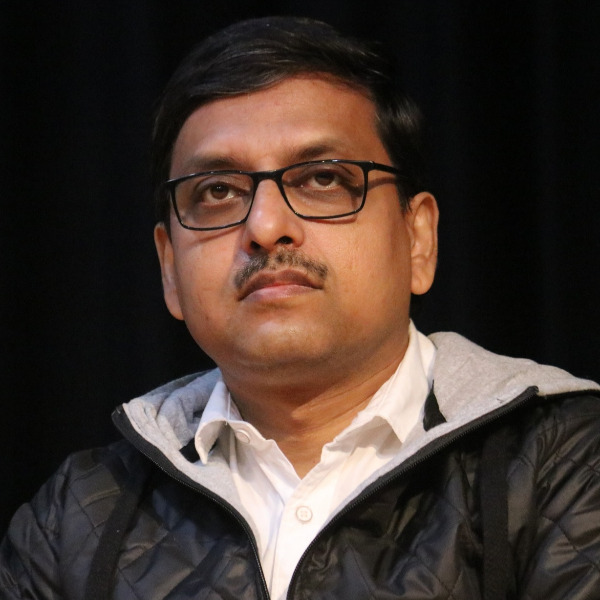
"The outcome is already there," says Ajay Gudavarthy. "People have overcome fear and reclaimed the narrative." In this interview, he traces how a protest that began over the NEET paper leak evolved into a larger critique of governance, democracy and state power. He also reflects on why Jantar Mantar has become more than a protest site—a space where solidarity, compassion and humour challenge fear and restore democratic agency.
Part-I
P: As a political theorist, you usually study movements from a distance. But this time you have been closely involved with the protests. You are on the ground. What made you step beyond the role of an observer? Has this movement changed the way you think about democracy and dissent?
A: In the sense that I have been visiting the site to understand, the primary purpose is to make sense of what is happening in the movement. Now, how do movements get constructed? One of the things that one notices in a movement of this kind is that it is a completely voluntary response from the youth and the students. There is no organised structure of the Left or political parties. Wherever I have interacted with people, they told me,
We saw the social media posts, and we thought it was important for us, for our own future and the future of younger people, and we came.
So, this is a completely voluntary involvement. It is a very spontaneous response from people who are otherwise not connected.
See, even other movements had a base. The CAA movement had a common religious basis. Other movements had a sectoral basis. This movement draws people from rural areas, small towns and cities. I saw people from very weak economic backgrounds. People could not even afford to travel. So, that means that the movement is much more organic. I think that will be the great strength of the mobilisation because it will then run on its own. It does not need any external incentive or artificial support.
P: Sir, you have been observing this movement grow over the past few weeks and months. As you said, how has it evolved? Has it become something much larger than the issue with which it began?
A: Yes. It certainly began with the NEET paper leak. It began with an educational focus. It began with the demand for the resignation of the Education Minister because that was the starting point. But now, seriously, it looks as though the movement has gone beyond NEET, beyond education, and beyond paper leaks. This movement has now become about the nature of governance.
It is about reclaiming citizenship, reclaiming the spirit of being treated with dignity, and reclaiming, I would say, the social contract with the state. Governments that are elected have to be responsive to people's concerns, and there are many legitimate concerns that people are raising. The question they are asking is: "Why is this government not responding?"
Therefore, I could see yesterday that the critique has gone beyond education to the model of governance that is being presented. I think it has become a very personalised critique of Mr Modi and Mr Shah's way of functioning. I foresee a very personalised critique, though without abusive language. People are extremely angry with this personalised form of governance that Mr Modi represents. It has taken a completely different turn now.
I do not think it is just about the resignation of those responsible. People are now moving to the question of the resignation of Prime Minister Modi. It has become a much larger issue about the nature of government in a democracy.
The basic issue is that the state should respond favourably to people. Instead, they have been treated like criminals. They have been treated like outsiders. They are not being heard. Excessive force was used against them. The movement has gone beyond its initial demands solely because of the nature of the response and the excessive use of force.
P: We have seen pictures of you speaking with the protesters and witnessing events first-hand. Which conversations or moments have stayed with you the most?
A: The most important? Students who had been beaten the previous day.
I saw certain students—for example, one student whose leg was broken. He was brought back to the protest site, being carried by fellow protesters.
I was taken aback by seeing how people with broken heads, hands and legs were ready to protest again. They were not taking it lying down or reacting with bitterness. There was a sense of humour. People were joking about their broken legs.
This combination is a very important one—the combination of raising grave and serious questions about the future with a sense of celebration and humour. It is sustaining the space now.
What it demonstrates is that people have overcome the fear that was instilled into them over the last ten years. That terrible sense of fear has disappeared.
People have already liberated themselves from it. The government can no longer rule through fear. People are in a mood of self-generated celebration. They have reclaimed the streets. They have regained their agency. They have reclaimed responsiveness. They have reclaimed the ability to question the government again, beyond all narratives of Hindu-Muslim, majority-minority and Pakistan.
People are simply asking the question: "We are students."
Everybody has become an Instagram creator, voluntarily making videos, making reels and posting them on Instagram and Facebook. This is an unusual spirit. The model of governance that was offered to us over the last ten years was based on so much fear. Other people have now liberated themselves from that fear.
It becomes a big challenge because they have also rejected the narratives.
Their narrative was that student protests were somehow illegitimate. There is a process now in which people are asking the question back to the government: "Name us. Who are we?"
So, I think the state and the government are at a loss for a narrative. They have also lost control of the narrative, and that is a major development.
People are asking, "What will be the outcome?" I think the outcome is already there. It is not something we have to wait for. Overcoming fear and reclaiming the narrative are the two immediate impacts of this movement.
P: This is absolutely out of syllabus for the rulers .
A: Again, people are coming back after being beaten and celebrating the movement. That, I think, is unprecedented. I thought people would be suffering so much after such violence. Instead, they are in a robust mood, narrating stories of how they resisted and defended themselves.
That is because they have larger questions. It is no longer just about NEET. They have linked the NEET paper leak to an unresponsive and opaque system of governance.
P: My next question is this: Protest sites often become more than places of demonstration; they become communities. So, how important are physical spaces like Jantar Mantar for keeping dissent alive in India today?
A: They are very important because, as I said, they represent the Zeitgeist, the spirit of the age. I could see people voluntarily distributing water, voluntarily distributing food, voluntarily distributing medicines. Somebody was cleaning, somebody was caring, somebody was distributing supplies. There were young people carrying away the waste. The spirit of the space was extraordinary.
It shows that this is very important for a struggle because you have already established a new norm. The entire model of governance wants to break the democratic spirit by producing loneliness. That was the project taking place in India.
This movement has, all of a sudden, disrupted that entire logic. People do not feel lonely; they are in solidarity and have become a community of protesters. They are not feeling scared; rather, they are jubilant. They keep returning in a humorous and celebratory mood.
So, I think space powerfully represents the reclaiming of the democratic spirit. It is wonderful to see because people were withdrawing into a deep sense of loneliness and suspicion of one another, unsure of whom to trust. Every discourse, everything one spoke in the public domain, was being criminalised, including spaces like universities, which are relatively freer spaces.
Every statement could be misconstrued, distorted or misconstructed. So, this space is important because it demonstrates something completely opposed to the spirit of governance that has been unleashed.
P: It is another important space for empathy, with so many people…
A: ...helping each other. People's compassion is clearly visible in the space.
Leaders have become incidental. Political parties have become incidental. They are not waiting for opposition parties to come. They are not expecting opposition leaders to come. Instead, people themselves are coming and joining them. They are acting on their own.
I think what they have realised is that waiting for someone important to come and help is not going to work in this country. They have also realised the limitations of the media. So, people are now self-organising. This is the true sense of democratic politics.
We are not dependent on parties. We do not need you to organise us. We do not need big leaders to come and represent us. We know what is happening.
Everybody has become a spokesperson. They are interviewing one another. Even when some media channels arrive, ordinary people themselves are responding and explaining, in great detail, what is happening in this country.
In other words, people understood what was happening a long time ago. The fear factor, the loneliness, the lack of clarity and the sense of doubt had been with them for a long time. That sense of self-censorship has now been broken.
This is a big challenge for the government because, if it is still not responsive, it will become very self-defeating and counterproductive. So, it will have to rethink its approach. Let us wait and watch how the government responds.
P: There are also instances from our neighbouring countries…
A: ...that remains in the memory of the people.
P: Yes, absolutely.
A: We have known for a long time that education is being destroyed. Education has become one of the strategies of the trans capitalist class across the world.
Universities have become enemies—from an advanced capitalist country like the United States to India. Education has been systematically undermined, especially institutions of higher education.
They have been criminalised. They have been commercialised. They have been placed beyond the reach of ordinary people.
Democracy requires a spirit of inclusiveness, where ordinary people can experience social mobility and realise their dreams. But when you cut funding to universities, shut them down, tell students they cannot speak in universities, cannot organise programmes and cannot hold academic events, you are destroying the very character of higher education.
This movement is also a resistance against that.
P: But we can say that they have lost faith in public institutions.
A: Educational institutions in places like northern Uttar Pradesh have deteriorated. We do not even have basic schooling in many places. Basic educational institutions simply do not function.
On top of that, students who do not receive a proper education try to make something of their lives by investing money in coaching institutions. Then you have paper leaks, fraudulent recruitment and corruption. You are making things so difficult and so impossible for them to survive that it becomes a basic existential problem for young people who are already living under severe economic distress.
You can see it from the way people are dressed. So many of them shared their stories with me. One protester told me, "I have not eaten since yesterday." Somebody else had only one hundred rupees with them.
That is the reality. This is how the majority of India's youth are living. Yet the way they articulated their concerns showed how much potential exists within India's demographic dividend.
But the ruling class simply wants to crush that potential. I think this movement will go a long way. It has long-term implications because people will now demand better educational opportunities and better public facilities.
I think the opposition parties should seize this moment and declare education a national priority.
Education has been systematically neglected—not only through underinvestment, but by making it increasingly difficult through repeated paper leaks. There have been over a hundred paper leaks under this government. Similar incidents have occurred in state governments as well, including Rajasthan.
This cannot simply be dismissed as coincidence. That is what people themselves have realised. One or two administrative failures can be excused. People have patience.
They invest huge sums of money in coaching institutions despite enormous hardships because they hope education will give them social mobility. But after making those sacrifices, they are left waiting endlessly, and in some cases are even penalised.
There is no hope left if the system continues to function this way. The government has made things so bleak.
This lack of responsiveness appears to many people as an attempt to cover up systemic failures. People now believe that this is not an accident but a design that denies them their future.
If this had happened once or twice in such a large system, people would have shown patience. Indeed, that is exactly what they did in the beginning. They thought perhaps someone had acted dishonestly or that there had been some technical failure.
But when it keeps happening, and after more than a hundred paper leaks there is still no meaningful response, no independent commission of inquiry and no structural reform, people conclude that the government wants to make this an ordinary part of everyday life.
Part-II will be published tomorrow