Joe Sacco’s The Once and Future Riot maps a massacre's many myths
A gritty graphic investigation into the 2013 Muzaffarnagar communal massacres—citing map errors and missing footnotes. Off the record, the real red line was a single sentence detailing the rise of Hindu nationalism. With no court order or government ban, Sacco’s refusal to sanitize his journalism exposes how private publishers censor unpalatable truths long before state censors need to.
Every book Joe Sacco has ever made, has been an argument against forgetting. He goes and sits in the wreckage until the forgetting stalls, as a massacre recedes into rumour or becomes a paragraph for history books. That has been the project since Palestine, and it remains the project in The Once and Future Riot, his account of the Muzaffarnagar in Uttar Pradesh.
The violence at the heart of the book began in August 2013, in the agricultural district of Muzaffarnagar in Uttar Pradesh – a dispute between a Hindu family and a Muslim man ended in his death. What might have remained a local criminal incident instead ignited into weeks of communal rioting across dozens of villages. By the time it subsided, more than sixty people were dead. Over fifty thousand had been driven from their homes, the great majority of them Muslim families who endured the following winter in relief camps without adequate shelter. More than thirty children reportedly died of exposure. It ranks among the deadliest outbreaks of religious violence in India since the Gujarat riots of 2002, a comparison whose weight Indian readers will register instantly and which Sacco takes pains to unpack for everyone else.
The riots erupted eight months before a national election, in a state where the Muslim electorate carries enough weight to decide outcomes. Sacco traces that thread to its most unsettling conclusion. His reporting contends that the Bharatiya Janata Party, India's ruling Hindu nationalist party, emerged from the resulting polarization electorally stronger. One local leader convicted of incitement in connection with the violence would later win a seat in India's parliament under the party's banner. This is the observation, ultimately, that would decide the book's fate.
Penguin Random House India had originally intended to distribute The Once and Future Riot domestically. The company then withdrew, presenting Sacco with an extensive list of requested revisions. On record, the publisher cited a map depicting India's borders inaccurately, along with source citations it claimed to have requested and never received. Off record, by Sacco's own account, the real objection was a single sentence near the book's close, describing Hindu nationalism as operating at full strength. He was told the line risked giving religious offense. He declined to remove it, and the arrangement collapsed.
It is worth noting that the Indian government never banned the book. No court order was ever issued against it. What transpired was narrower, and in certain respects more damning: a private publisher deciding, unprompted, that a rigorously reported work of journalism was too hazardous to release under its own imprint. Critics within India, including journalists who had covered Muzaffarnagar themselves at the time, denounced the decision as spineless, noting that the substance of Sacco's account had already circulated widely in the Indian press years earlier.
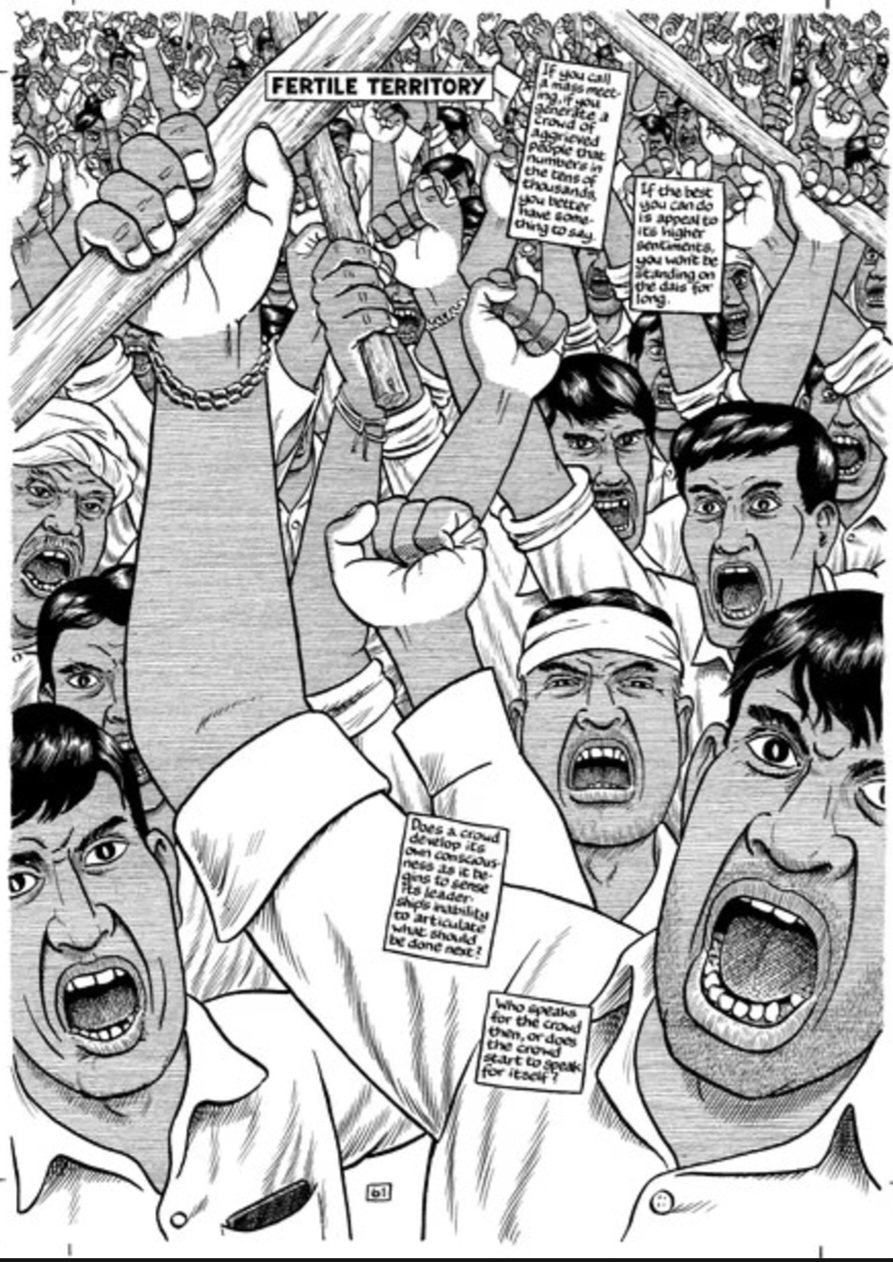
The controversy would merit sustained attention if the book did not earn it. Sacco's method here is the one he has refined across three decades. He travelled to the place, spent years sitting with residents of Uttar Pradesh, in their homes, in relief camps, in government offices transcribing what he heard into the same obsessive, textured linework he has employed since the early nineties. The book moves fluidly through the testimony of Hindu villagers, Muslim families in mourning, local police, and political operatives, allowing each account to sit unresolved beside the others, rather than compressing them into a single authorized version of events.
That refusal to resolve is, in essence, where the book succeeds. Sacco demonstrates how a village, and by extension a nation, manufactures divergent narratives from an identical set of facts, depending entirely on which side of the violence a person occupied. Men complicit in the killings rationalize their own culpability, officials shade their recollections to shield themselves or their party, victims spend years fighting simply to be believed. Sacco allows these contradictions to remain unreconciled, a considerably harder and more honest editorial choice than it might initially appear.
There are broad, almost cartographic spreads of the flat farmland surrounding Muzaffarnagar that anchor the violence in a traceable geography rather than permitting it to drift into abstraction. And there are tight, discomfiting panels of individual faces caught mid-testimony. Sacco draws people listening with the same rigor he draws people speaking, a remarkable skill in a book constructed entirely from conflicting accounts.
Sacco has spent nearly four decades constructing, and subsequently perfecting, the genre now known as comics journalism. Palestine and Safe Area Goražde established the template early: sustained, deeply reported nonfiction rendered in comics form, with Sacco frequently drawing himself into the frame as the outsider taking notes. Footnotes in Gaza carried that method into historical excavation, unearthing a largely forgotten 1956 massacre through the testimony of its few remaining survivors. Paying the Land turned the same patient, polyphonic approach toward Indigenous communities in Canada's Northwest Territories.
The Once and Future Riot belongs within that lineage and also returns to a preoccupation that runs beneath nearly everything Sacco has made: what occurs when a state's institutions look away from violence against a minority, or worse, discover a use for it. Sacco has said as much himself, describing Muzaffarnagar as one instance of a pattern recurring across democracies well beyond South Asia, wherever electoral arithmetic and communal division begin to sustain one another.
This book reaffirms what is already evident to readers familiar with Sacco’s catalogue - that he remains comics' most exacting practitioner of journalism's harder, less glamorous labour, the sustained presence required until people begin, finally, to tell the truth. Thirty years into that project, it is telling that a publisher still found reason to walk away from it.