The visual history of Milad-un-Nabi: What to remember
From Mughal courts and Ottoman mosques to Cairo’s crowded streets and Hyderabad’s Milad processions, centuries-old paintings and photographs preserve how the Prophet’s birth was celebrated — and how faith became public memory.
Birth of the Prophet Muhammad. Miniature illustration on vellum from the book Jami' at-Tawarikh (literally 'Compendium of Chronicles' but often referred to as 'The Universal History or History of the World'), by Rashid al-Din, Tabriz, Persia, 1307 CE, now in the collection of the Edinburgh University Library, Scotland.
Milad has rarely been only a date on the religious calendar. Across centuries, its celebrations have also left behind rich visual records of how rulers, communities and cities chose to make devotion public. Visual memory from Mughal India, Ottoman Turkey, Egypt, China and Indonesia offer a brief journey through that visual vocabulary. The vocabulary that with time became a reflection of ‘who was celebrating’.
One of the earliest and most striking images in the archive takes us to Mughal Agra. A painting titled A Night Celebration of the Prophet’s Birthday records a Milad gathering associated with Shah Jahan’s court on September 16, 1633. The work is attributed to Bulaqi, son of Hoshang, and dated to around 1635; it is now part of the Smithsonian’s National Museum of Asian Art collection. The painting shows Shah Jahan seated among Muslim theologians and members of his court, with prayer preceding a feast.
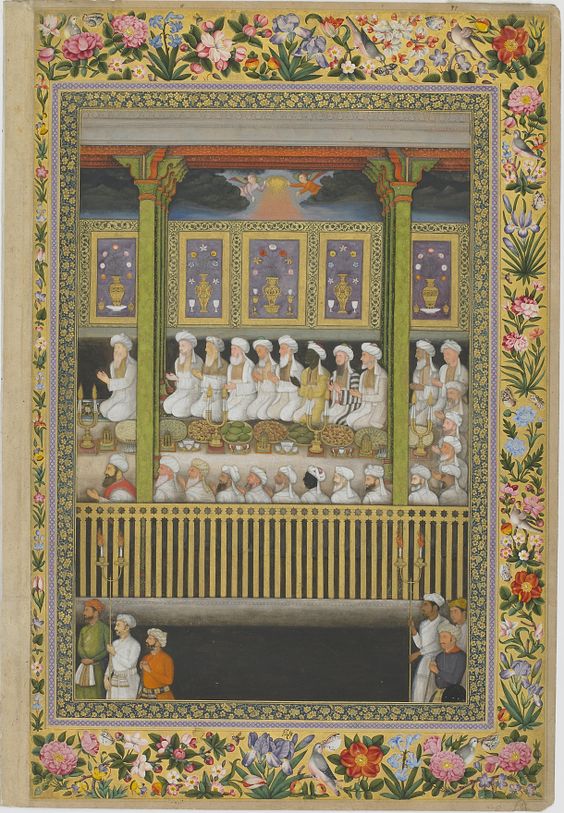
A night celebration of the Prophet’s birthday. Agra, Divan-i ʿAmm, September 16, 1633. Attributed to Bulaqi, ca. 1635” detached from the St. Petersburg Album, right half of double-page, Washington.
The distinction between the date of the event and the date of the painting is important. The gathering took place in 1633; Bulaqi’s painting was produced approximately two years later. Its borders were added much later, in 1751–52, by Muhammad Sadiq.
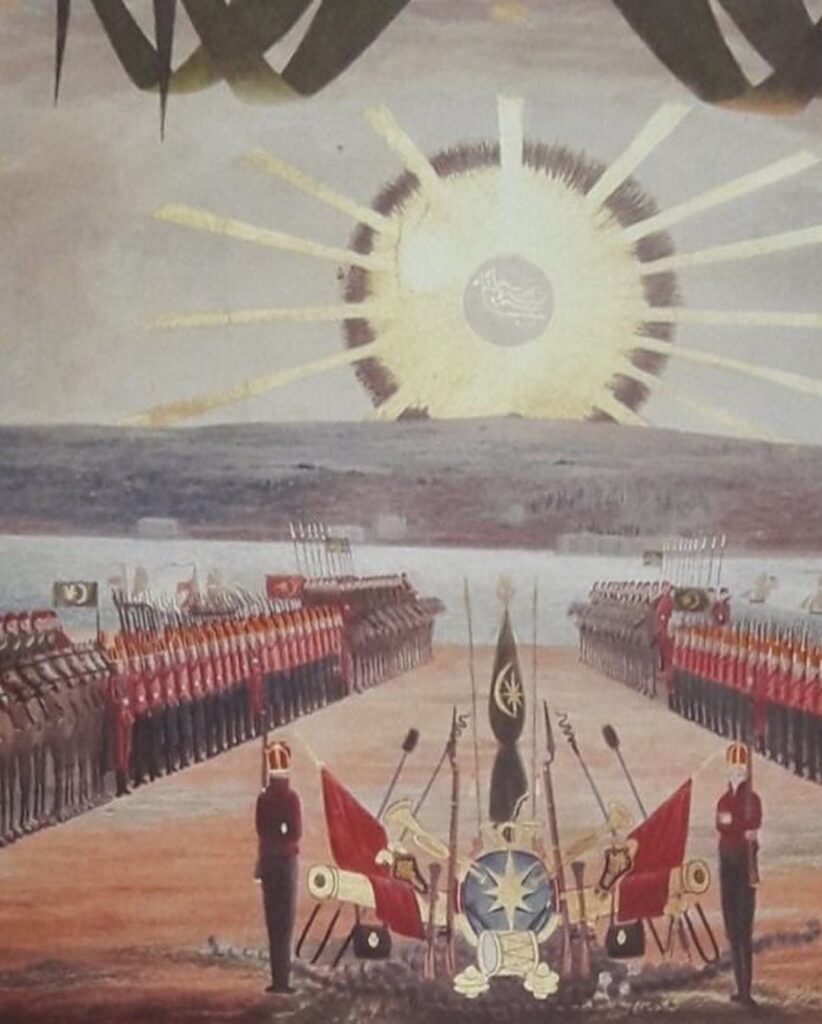
From Mughal court to Ottoman Istanbul, the setting changes. An early-19th-century image in the visual archive depicts a congregational Milad gathering at the Sultan Ahmed Mosque. Here, the palace gives way to the mosque and the visual emphasis shifts towards collective worship. The archive associates the image with the reign of Sultan Mahmud II, although it does not identify a painter, making attribution more cautious than in the Mughal case.
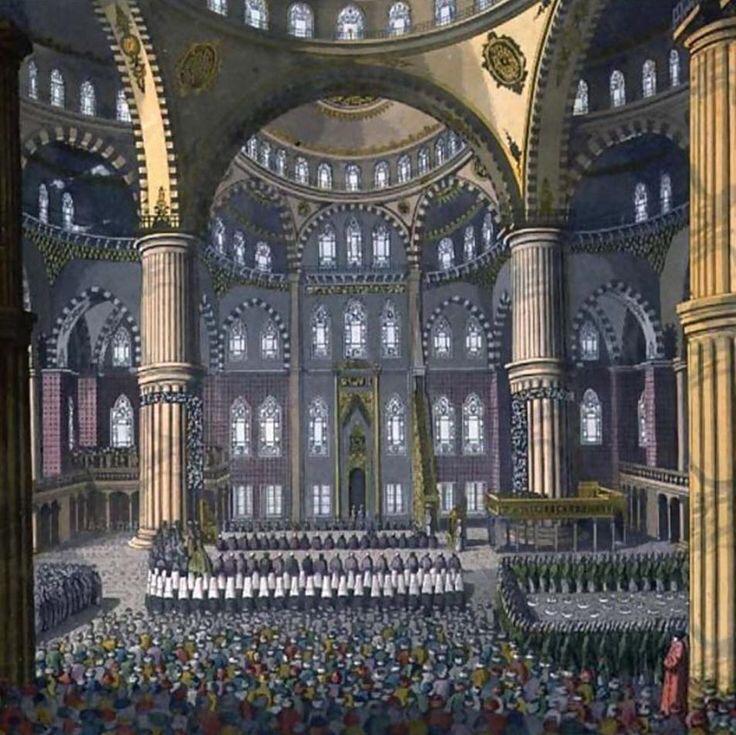
A congregational gathering of Eid Milad Nabwi, Sultan Ahmad Mosque, Istanbul, Turkey, C early 19th century attributed to the reign of Sultan Mahmud II Sultanate.
By the late 19th century, the visual record moved decisively into the street. An Ottoman Imperial Archives image dated October 15, 1891 shows a Mawlid procession with flags and organised formations. In Cairo, Gabriel Lekegian’s circa-1880 photograph captures another dimension: Milad as an urban spectacle of crowds, flags and illumination. A 1904 Cairo procession further documents the festival beyond the confines of court or mosque.
The archive then widens geographically. A photograph from around 1908 records Hui Muslims in China marking the Prophet’s birth anniversary, while a late-19th-century image of an Indonesian procession shows how Mawlid had entered the public streets of Southeast Asia. The visual forms differ, but the recurring elements — gathering, movement, flags, ritual and community — remain strikingly recognisable.
A photo of Hui Muslims celebrating the birthday anniversary of Prophet Mohammad, Eid Milad Un Nabi, in China, c 1908.
India offers another layer to this history. In Hyderabad, Milad observances can be traced to the Qutb Shahi period. Muhammad Quli Qutb Shah celebrated it through poetry and festivity; Abdullah Qutb Shah later revived and expanded the celebrations, bringing musicians from India and Iran and incorporating substantial charitable giving. Under the Nizams, Milad acquired further institutional patronage, with 1922 firmans recording allocations for celebrations and a Central Milad Committee.
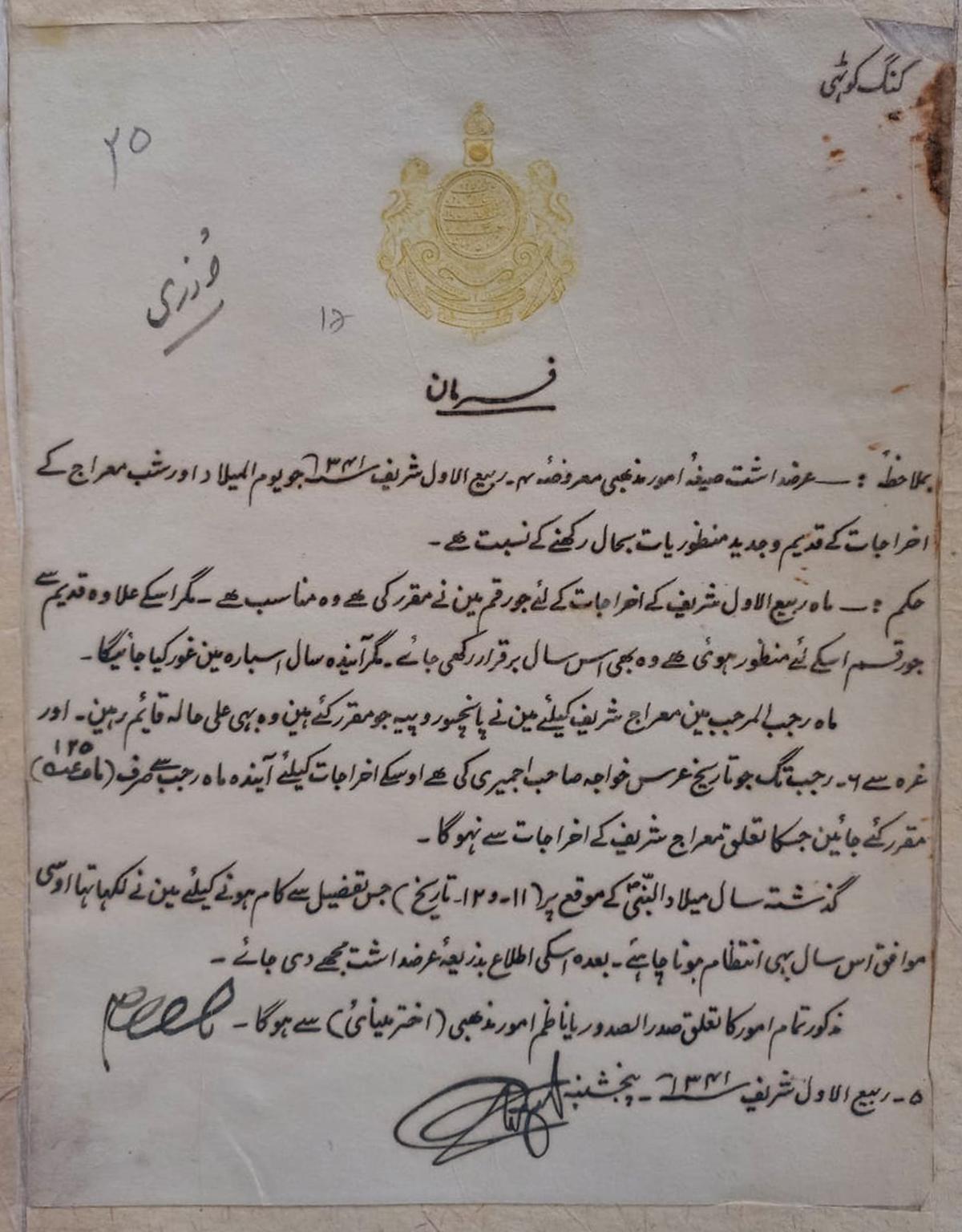
A firman regarding allocation of funds for Milad un nabi celebrations.
After 1948, the celebration entered a different political landscape. Abdul Wahed Owaisi organised a Milad Jalsa in 1958, while the Tameer-e-Millat tradition developed another important public forum around the Prophet’s life. Today, Hyderabad’s Milad programmes can include lectures, blood-donation camps, CPR training and assistance with bail for undertrials.
Seen together, these archives suggest a history not of one fixed celebration, but of a festival continually acquiring new visual forms — from the Mughal court and Ottoman mosque to illuminated streets, public processions and community service.
Milad un nabi celebrations at Hyderabad.
The paintings and photographs do not merely show how Milad looked. They reveal how different societies chose to make faith visible.
Milad-un-Nabi, now observed across much of South Asia through prayers, sermons, processions and communal gatherings, has travelled far beyond its early centres of celebration. From Egypt, where the Fatimids formally institutionalised the observance, the Mawlid spread across Muslim societies, acquiring distinct local forms while retaining its focus on remembering the Prophet’s life and teachings.