Belonging but on her own terms
Sonia Gandhi’s Belonging is both a personal act of remembrance and an attempt to reclaim her place in India’s political and cultural imagination. Through memories of Rajiv and Indira, she offers a revealing account of love, loss and power.
A woman once seen as an outsider, telling her story of love, loss and belonging.
The thing you notice first about Belonging is that Sonia Gandhi has gone out of her way to say it isn't really a political book at all, that it's meant to be the story of her love for Rajiv and Indira and the country she moved to, with politics sitting mostly in the background like furniture. This is a slightly absurd claim coming from a woman who led the Congress for two decades and presided over a coalition government for ten years, so that the whole question of how to read the book turns on whether you accept her framing.
It is significant that Belonging opens with a hymn from the tenth book of the Rig Veda, the Samjnana Sukta, which asks its listeners to move together and speak together and goes on to call for a united purpose and harmonious hearts. It is hard to imagine a more deliberate way for Sonia Gandhi to introduce herself to readers who spent years casting her as an Italian outsider. A ‘mantra of unity’ from the oldest Hindu text, placed before the first page, is an assertion of civilisational belonging. The choice is also glaringly political, coexisting with the irony that the invocation is familiar in the Sangh tradition as well. The Congress leader has chosen to open with a text of collective purpose that her opponents also claim as their own. It is a bid to reclaim the vocabulary of Indian unity that had, in recent years, been lost to them. It seeks to restore the secular Congress that represents the idea of an India that draws from its ancient roots while ensuring there is room for everyone.
Sonia admits that the Emergency was a mistake, and that frankness throws me off as someone who, having grown up through the Congress’s second downfall, always presumed to have a general idea of what Sonia’s personality was like. Sonia believes that Indira Gandhi eventually came round to the same view and that if Sanjay had been kept in check, much of the damage might have been avoided. This account unfolds in a family dinner scene in which Rajiv urges his mother to wait for the next election while Sanjay insists that the Opposition will destroy her unless they are stopped. Sonia’s claim that Indira was a democrat at heart who was never comfortable with what she had done is the sort of thing she herself concedes many people will laugh at, which, at least, is honest of her.
In 2004, when the Congress-led alliance wins a victory, party elders beg her to take the reins. Her own children apparently confront her about it, given that they had already lost a grandmother and a father to assassination. She retreats to her bedroom and eventually settles the matter by listening to an inner voice. This pompous renunciation story is saved by the fact that she then explains her choice of Manmohan Singh. Her reasons are brutally practical. She notes that he belonged to no faction in the party and that a government supported by the Communist parties would need a prime minister who could reassure sceptics about its ability to manage the economy. This is a coalition argument, something the Congress has always relied on and still does to this day. It is an argument about who could hold a fragile arrangement together and tells you a lot about how she thinks about power: as something to be maintained before it can be used for good.
She addresses the old charge that she was the real power behind a subservient prime minister and claims that there was an unspoken division of labour in which Singh ran the government and she ran the party. She says she never interfered in administration or looked at official files and that she respected the boundaries of her position. This is a denial that people will accept or reject almost entirely according to what they believed before they opened the book, which is more or less the fate of all such denials.

The Varsity restaurant in Cambridge, where Sonia and Rajiv first met.
Sonia’s relationship with Rajiv is perhaps where the book is most alive, from their first meeting at a Greek restaurant in Cambridge in 1965 to their final conversation in May 1991.
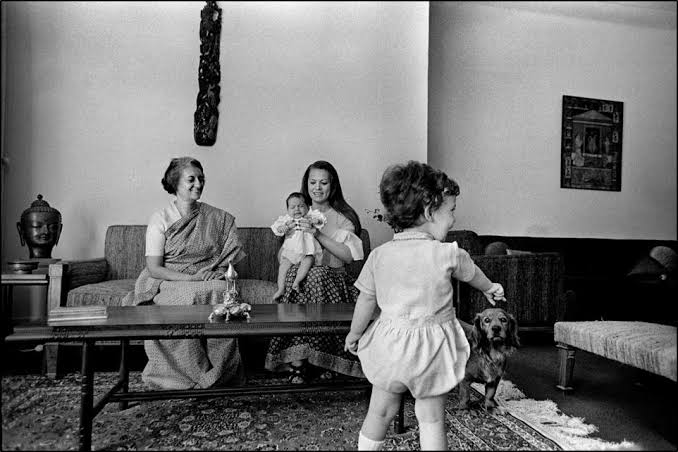
A tender family moment with Sonia Gandhi, capturing a glimpse of life beyond the public eye.
Everything in between is a marriage told through familiar domestic details: a bride who learned Hindi, a mother-in-law whose temper could leave staff frightened enough to be made to stand in a corner and a first child, born prematurely in 1969, who died shortly after birth and whose remains she insisted be buried. Rajiv changed diapers at night so she could sleep. The romance, at least, is deeply convincing, even if other things about the book are not.
There is surely a lot that the book leaves out, even if you read it as a personal act of remembrance rather than a political justification. But the sense of a grief carried quietly through years of public duty lingers even after the last page, as does the portrait of a woman long described as a stranger who has given this country, and lost in it, more than most people born there.
The fairest way to judge Belonging is against what political memoirs actually are, which is rarely memoirs and almost always cases for the defence. By that standard, this one is more honest than most. Even so, it doesn't turn the same candour on the party she led, which might lead a reader seeking accountability to close it disappointed. Someone who wants to understand how Sonia Gandhi would like to be understood, however, will find it revealing.