Tawayafnama: Reviving the lost legacy of India’s iconic courtesans
Tawayafnama dance drama: Directed by Dr Soma Mukherjee, this researched dance-theatre production revisits the forgotten legacy of India’s courtesans, celebrating their contributions to classical music, dance and the freedom struggle while illuminating their resilience, artistic brilliance and place in India’s cultural history.
The cast of Tawayafnama takes a final bow, celebrating the forgotten legacy of India’s courtesans through music, dance and storytelling.
India’s musical and cultural history is profoundly enriched by the lives and legacies of its courtesans, or tawaifs, whose artistry shaped the golden eras of classical music and dance. Often misunderstood or forgotten, these women were custodians of refined art forms, preserving and advancing India’s cultural heritage during times of social turbulence.
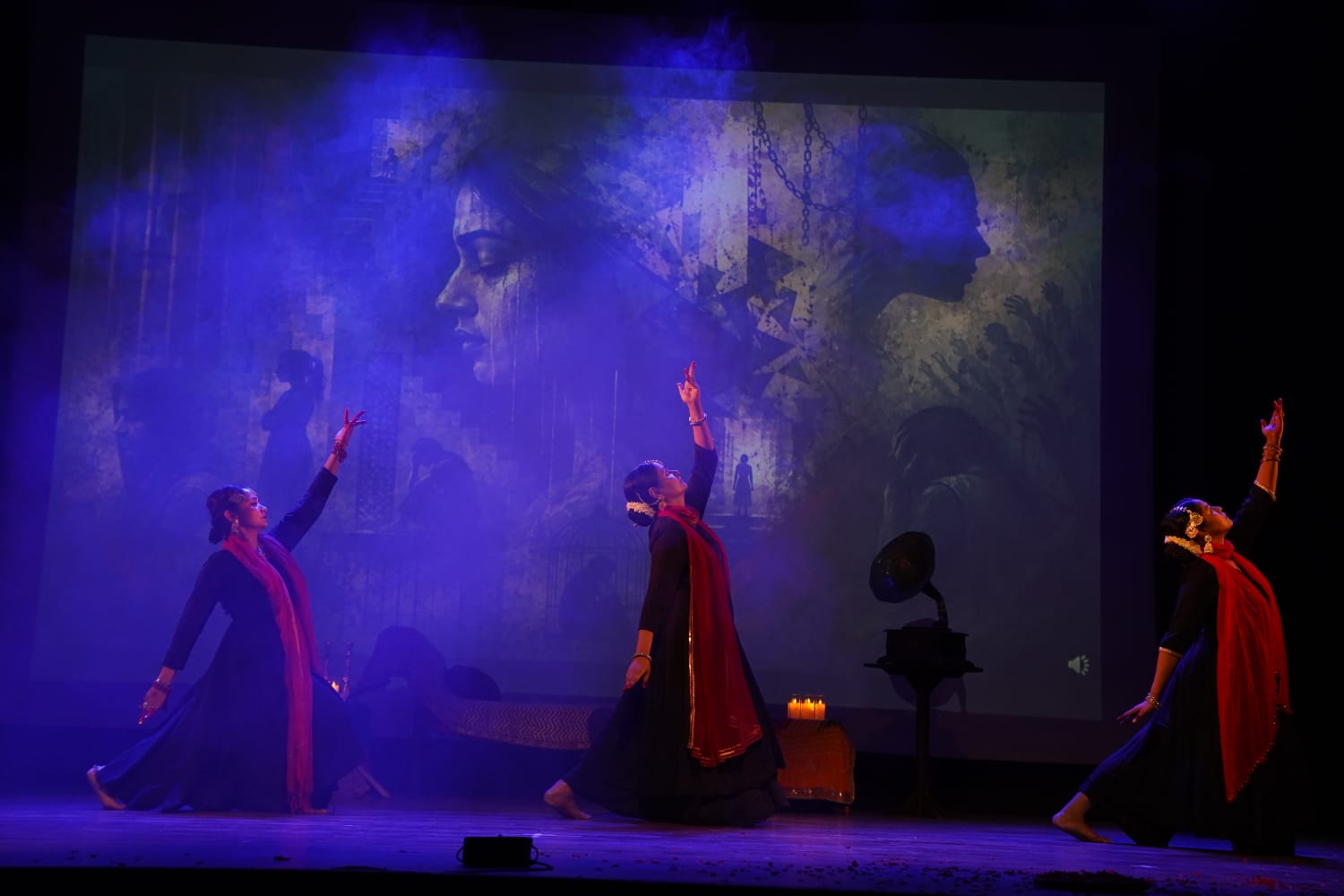
A scene from Tawayafnama.
Tawayafnama, a powerful dance-theatre production directed by Dr Soma Mukherjee, draws inspiration from Vimal Kumar’s book by the same name to illuminate their extraordinary journey from the early 1900s onwards.
The production brings to life the stories of legendary courtesans who were far more than entertainers. They were intellectuals, revolutionaries and cultural custodians who wielded music and dance as tools of self-expression and resistance. Among them is Gauhar Jaan, celebrated as the voice of an era and India’s first celebrity singer. Born Eileen Angelina Yeoward, Gauhar Jaan was the pioneering artist to record on the gramophone in 1902. A disciple of Kathak maestro Bindadin Maharaj, she was a consummate dancer and poet whose experimental musical style laid the foundation for India’s recorded music industry.
Another luminary, Vidyadhari Bai, born in 1881 in Jasuri village, was renowned for her mastery of khayal, thumri, tappa, ghazal and bhajan. A devoted supporter of the freedom movement, she famously donated her earnings to revolutionaries and performed songs of resistance at Mahatma Gandhi’s request. Through the founding of ‘Tawaif Sabha’, she fostered the participation of tawaifs in India’s freedom struggle, while her multilingual repertoire and writings echoed an unwavering spirit of patriotism.
Bibbo Jaan, born Ishrat Sultana, emerged from Delhi’s rich singing traditions to become a prominent film actress and singer in Bombay during the 1930s and 1940s. Known for her distinctive husky voice, she worked with noted directors and featured in popular film songs that have retained their charm through generations.
The production also honours Asgari Bai, a distinguished dhrupad singer awarded the Padma Shri and other accolades for decades of mesmerising performances spanning Madhya Pradesh and beyond. Akhtari Bai, better known as Begum Akhtar, hailed as the ‘Mallika-e-Ghazal’, was revered for her mastery of ghazal, thumri and dadra, and her expressive voice earned her the Padma Bhushan.
Rasoolan Bai’s contribution to the thumri gayaki of Poorab Ang remains unmatched. Her rich, emotive vocalism and expert command of intricate musical nuances made each performance breathtaking, securing her place as one of the most revered figures in Indian classical music.
Janki Bai Allahabadi, affectionately known as Chappan Churi (the woman of 56 wounds), brings to the fore brave resilience alongside extraordinary talent. Trained in multiple languages and art forms, her life bore witness to the harsh realities tawaifs faced under colonial rule. Surviving a brutal attack yet continuing to captivate royal courts with her voice, she was among the earliest women to have their music recorded on the gramophone.
Adding grandeur and soul to Tawayafnama is the live musical performance by Samadrita Chowdhury. Her rich, emotive voice channels the essence of thumri, dadra, kajri and bhajan, breathing life into the musical heritage of the courtesans. The choreography features exquisite Kathak sequences, showcasing intricate footwork and expressive abhinaya as it spins tales that evoke the emotions and stories of these women.
Tawayafnama transcends being a mere performance. It is an ode to women who refused to be forgotten, shining a light on their resilience, empowerment and artistic brilliance. This production invites audiences to witness a century-long history in which courtesan artistry was both a form of resistance against societal and colonial dominance and a beacon of India’s rich artistic wealth. It is a narrative of legacy, identity and unyielding spirit.
It’s an authentic, original work, where each and every segment has been presented after ample research. We have tried to showcase the original songs of tawaifs, such as ‘Chun chun ke phool’ by Vidyadhari Bai during the freedom struggle, ‘Jamuna Tat’ by Janki Bai, ‘Mere humnafas’ by Akhtari Bai, the iconic song ‘Raske bhare’ by Gauhar Jaan, and ‘Aane ko muntzar’, as rare original songs and music.
This grand tribute is brought alive by The Performing Arts Tribe, a vibrant collective founded in 2023 that unites over 500 artists and art lovers across Delhi NCR and beyond. Known for productions that blend classical music, dance, theatre and storytelling, the group celebrates forgotten histories with artistic rigour and passion, engaging audiences at prestigious venues including the India International Centre, Civil Services Officers’ Institute, The Apparel House, Gurgaon, and the ICCR’s Satyajit Ray Auditorium, among others.
By retracing the footsteps of the tawaifs through Tawayafnama, The Performing Arts Tribe not only preserves an essential chapter of Indian culture but also honours the enduring legacy of these extraordinary women who, through their art, shaped the ethos of a nation.