Why didn’t grand narratives work this time? looking inside the lingua franca of Gen Z
Can a government spend nearly ₹5,987.46 crore on publicity over a decade and still lose control of the narrative? This essay argues that India's grand political spectacle encountered an unexpected challenger: Gen Z's meme culture. Satire, irony and internet humour punctured carefully manufactured narratives, replacing fear with laughter. As Rahul Gandhi remarked, "Narendra Modi's India is past, and the past can never fight the future."
Primary dissonance between the two opposing political factions in contemporary India is based on their futuristic imaginations of this country. The attempts of the latter are, meanwhile, to conjoin diversified representational agencies of the country; the former remains occupied in sharpening its modus operandi of fitting India into a singular monotheistic framework. This hegemonic project of the Right is a mechanism that intends to mask the uneven economic developments of the country and disguise its obsessive habit of involving in crony capitalism. It, thus, puts all of its strengths into creating spectacles to manufacture a popular consent of submission to their grand narratives.
To make it clear, by narratives I mean the all-pervasive dominant language of the powerful; while spectacles are the audio-visual/public demonstrations of those narratives. The current regime, which took charge of office in 2014, has been calculative in building grand narratives that would, in return, sustain them to continue their dominance. These grand narratives are like pieces of a jigsaw puzzle. They never appear in totality but permeate our surroundings (ranging from inescapable large billboards to the cohort of extremely opinionated IT Cell spokespersons) and form a total image only in one’s mindscape.
A brief look at the current regime’s expenditure on building narratives through different means of advertisement might give us a clue about its desire to colonise the collective psyche. Seema Chishti, in a recent piece, reveals that from 2014-15 to 2024-25 the BJP-led Union government has spent a total amount of Rs 5987.46 crore on advertisement and publicity, which is roughly 1.5 crore a day. This expenditure on publicity helped the regime attain a gigantic state machinery that looked indomitable and unbreachable for rivals who were keen on using conventional modes of political resistance.
Continuation of this political situation has turned the air around us dense with pessimism. Growth of dissents was crushed with sedition. Organised protests were labelled as obvious foreign-funded projects to undermine the state’s sovereignty. Waiting for the opposition has literally become a ‘Waiting for Godot’-like situation as the succession of their attempted failures to counter state-aided narratives only gave extra mileage to the state’s formation of their intended hegemony. Such stalemate political impasses ultimately lead to the delusion of living in a circular time and losing the most radical of all instincts – ‘Hope!’
Restoration of hope was little expected to emerge from a mere joke which eventually culminated in a phenomenal demonstration of peaceful democratic protest. The agitation we witnessed in the last two months, if seen from a broadly political lens, is nothing but a repetition of history where the ground beneath the feet of the powerful slipped away in a familiar manner; but if scrutinised by taking into account the minutest details possible, then the distinguishing factor of this movement was its, perhaps unconscious, application of a language to refute state-imposed gigantic narratives.
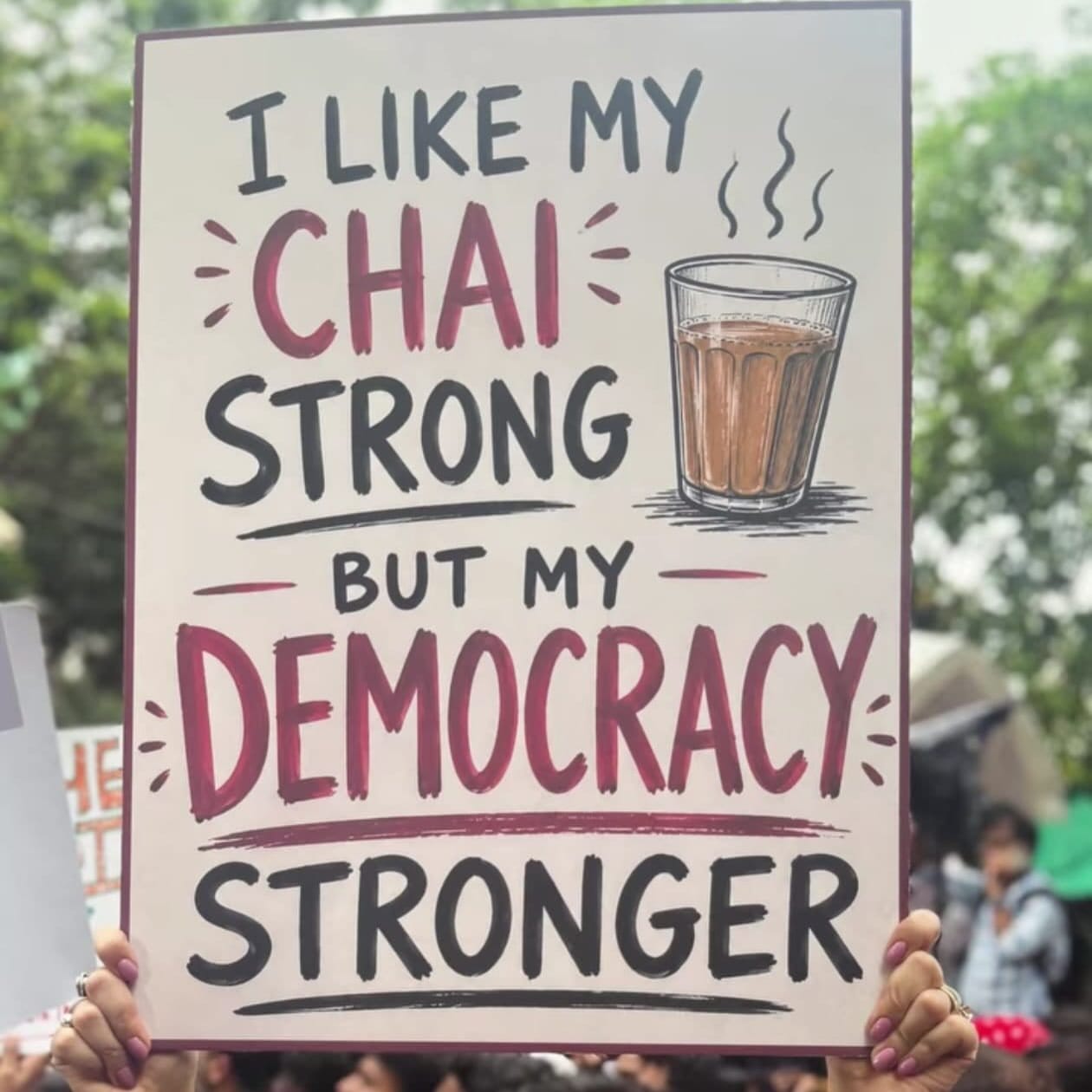
A poster showing that Gen Z prefers a stronger democracy over strong tea.
The language was essentially satirical, and it was unconscious because the major driving force, Gen Zs, of the movement grew up in a technocratic habitation where the expression of even elemental feelings was articulated through memes. This neo lingua franca of memes breached the grand narratives of state machinery, and the state found it arduous to humble the protesters with its clichéd homogeneous narratives. As a result, the indomitable IT Cell collapsed, and the state reacted with expected brutality.
The reaction with police brutality in the NCR and other pockets of the country was expected, but the satirical response to it was not.The language of the protesters tells an entirely different story. Students asking the police to use water cannons, playing with guardrails, making fit-check videos against the backdrop of a deployed force, recreating the "vasteguna Huiya" moment with police, and stealthily opening the gate of a van carrying detained protesters are unforeseen events. Meanwhile, the state project of building ironclad cults of its ministers found a rebuttal with memes addressing the education minister as ‘Kuchupuchu.
On the other hand, the state project of building ironclad cults of its ministers found a rebuttal with memes addressing the education minister as ‘Kuchupuchu.’ Allegations of infiltration of foreign funds, this time, were not refuted with an angry demand for evidence; rather, they were mocked by a guy who said, ‘Yes, yes, I received 40 rupees this morning from Pakistan. I spent it on my metro ticket. Now I have to ask Nepal to send me another 20 bucks to buy a return ticket.’
A case study of the X handle of Cockroach Janata Party could reveal an alternate language of dissent. The ongoing hunger strikes and protests amid adverse environmental and state-created situations, instead of posting solemn press releases, found expression in its regular posts stating ‘Priya Mantriji, instipha dijiye’ (Dear minister, please resign) with particular emoticons people use while talking to their loved ones. This replaces the conventional language of rage and anger with a certain idiom that is rooted in love and doesn’t necessarily alienate the masses from their political rivals.
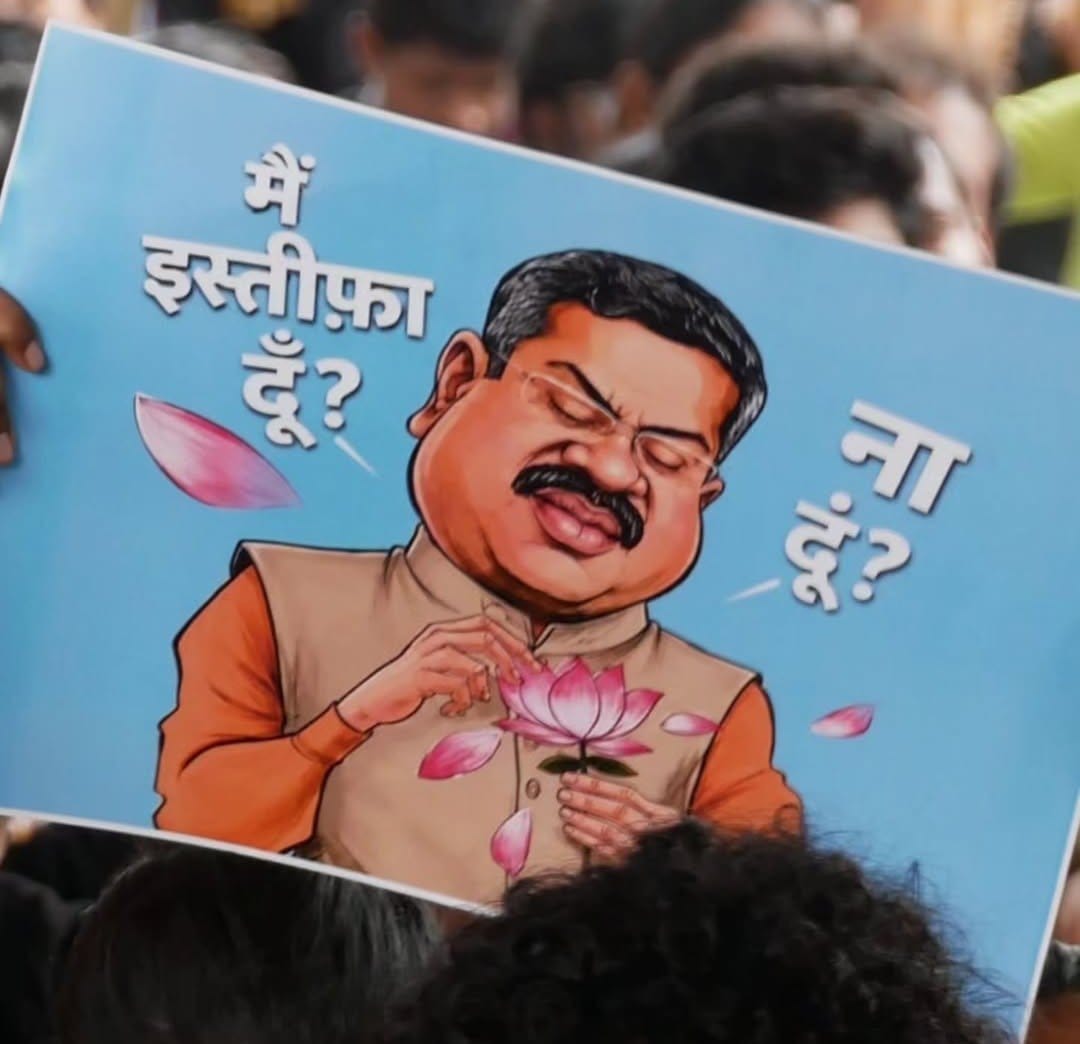
A poster depicting the former education minister playing 'Love Me, Love Me Not!'
Potboiler memes and deadpan humor, which emerged out of this movement, resettled the popular political discourse in India. The Prime Minister thought it necessary to depart from his familiar ‘Mitrons’ and address the masses as ‘friends’; a BJP MP criticised its parliamentary opposition by saying, ‘They protested because they were having FOMO, and currently they’re having a delulu of accruing popular support.’ However, this restructuring of the dominant framework only allows an overflow of satirical criticism that reflects the overcoming of fear to democratically criticise the power again and pushes the powerful into a relatable position with Joe Pesci from Goodfellas, where they find themselves asking, ‘Funny how?’
From the bits and pieces of the chronicles of the protest, if a total image is drawn, it carries an inkling of a new age of political dissent in India. All-inclusive democratic mass movements have attained a new language that metamorphoses angry, rageful protests into a carnival where participants can dance while chanting slogans and carry a microphone to mimic the most powerful person in the country. To reiterate Rahul Gandhi’s words, Narendra Modi’s India is past, and the past can never fight the future!