The Viksit Bharat paradox: India’s schools still need water and toilets
School Theek Karo Movement: As India marks 80 years of Independence, the deteriorating infrastructure of rural government schools is emerging as a subject of national debate. In Bankura, local BJP workers have been accused of attacking a minority volunteer and his father, who later died, allegedly because of his participation in the Cockroach Janata Party’s ‘School Theek Karo’ campaign. In Lucknow, a student protest has brought renewed attention to the deeper crisis confronting India’s rural education system. The movement can also be viewed as a call for a “second independence” in education—one that seeks to challenge the enduring legacy of colonial education policy in independent India.
Standing at the moment of celebrating the 80th year of India's independence, when our 'Vishwaguru' is dangling dreams of a 'Viksit Bharat' on all sides, right then, not on television screens, but across digital social media, images of the appalling state of infrastructure in rural government schools across the country are surfacing. Broken windows of schools are visible, an absence of safe drinking water is visible along with filthy toilets—this very sight is now the face of the public education system in village after village of India. Challenging this reality, the 'Cockroach Janata Party', fresh returnees from Jantar Mantar, has entered the fray. Their nationwide call for the 'Fix the School' ('School Theek Karo') movement cannot be termed merely a political programme; rather, it can be identified as a deeply critical crisis of India's post-colonial education system and an effort towards 'decolonisation' against the colonial mindset in education.
Last August 15, on Independence Day, CJP founder Abhijit Dipke launched the 'Fix the School' campaign in his native village of Santuk Pimpri in Hingoli district, Maharashtra. Inspecting a local government school there, he observed broken classroom windows, a lack of drinking water supply, an absence of adequate benches, and filthy, unhygienic toilets. He raised the question: which child can use this toilet? The primary objective of this campaign is to improve accountability regarding the infrastructure of rural government schools. Not only that, a demand to impose a legal limit on private school fees has also been raised by the CJP.
The most critical aspect of this campaign is its 'mass-social audit' method. The CJP has called upon citizens to visit the government schools in their respective villages to verify the condition of basic amenities such as drinking water, toilets, electricity, and security. Through a specific form—they will collect data on the current state of these schools and present the report publicly in the future. This initiative primarily encourages direct citizen participation in India's democratic structure, which can be read as a landmark step regarding education policy in post-colonial India.
While this movement is gaining momentum across the country on one hand, a tragic incident has occurred in Karishunda village under Indas police station in Bankura district, West Bengal. A CJP volunteer, local youth Sheikh Abdul Hafiz, visited his former school, Karishunda Primary School, as part of the 'Fix the School' program. There, he took photographs and recorded videos of the school's dilapidated infrastructure. On the night of August 13, several individuals launched an attack on his house. According to the family's allegation, the attackers assaulted Hafiz and his elderly father, snatched his mobile phone, and forced him to delete the video of the school along with videos of his agitation at Delhi's Jantar Mantar. Hafiz's severely injured father passed away on Saturday. CJP co-convenor Ashutosh Ranka directly blamed the BJP for this attack. CJP founder Abhijit Dipke strongly condemned the incident and demanded the immediate arrest of the culprits.
This incident proves that just as ordinary citizens begin to raise questions nationwide on issues like the quality of rural school education, established centres of political power are becoming intolerant. The death of Hafiz's father has brought the movement into proximity with a 'martyr', which seems poised to intensify this struggle further. Not only CJP volunteers, but school students across various regions have also become vocal in claiming their rights. In Lucknow, Uttar Pradesh, students of Jayprakash Narayan Sarvodaya Vidyalaya took to the streets in protest, highlighting issues such as the lack of subject teachers and various irregularities in the school. These students of the 'Gen Alpha' generation staged a demonstration on the local Bhudheshwar-Mohan Road. Although police reached the spot upon receiving the news, the most notable aspect of this protest was the role played by the state's Social Welfare Minister, Asim Arun. En route to Kannauj, he was forced to stop upon seeing the demonstration, spoke with the students himself, and escorted them back to their school. He assured the students that measures would be taken to fill teacher vacancies and that coaching arrangements would be made for them under the Chief Minister Abhyudaya Yojana.
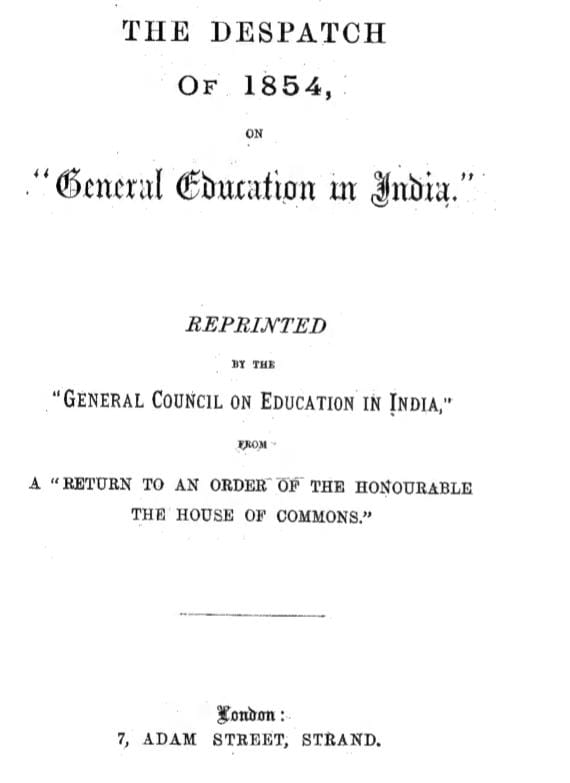
This Lucknow incident proves that the discontent surrounding the quality of school education prevailing across rural areas is no less prevalent in urban areas. Seeing the deterioration of government schools and the growing rage of ordinary citizens and students against it, we ought to understand that the roots of this problem run deep. The education structure created by the British government in India through 'Wood's Despatch' in 1854 was essentially a framework designed to build a 'ruling class'. Through the Downward Filtration Theory, educational opportunities were restricted exclusively among upper-caste Hindus. In Macaulay's infamous Minute (1835), Indian knowledge was termed 'darkness', and Western education was unilaterally imposed upon this country. It is as a result of this historical process that India's education system continues to bear the burden of a colonial mindset today. In the language of instruction, curriculum, and administrative structure—that colonial imprint remains clearly visible in everything.
In the National Education Policy (NEP) 2020, emphasis has been laid on Foundational Literacy and Numeracy (FLN). However, the latest report from the Annual Status of Education Report in India states that more than half of the children in Grade 3 in rural India cannot read a Grade 2 textbook. Only 50% of children in Grade 5 can read a Grade 2 text. Infrastructural problems in government schools and the lack of teachers there are responsible for such a state of affairs. The 'School Complex' model mentioned in the National Education Policy 2020 has not yet been operationalised. The number of small and unregulated schools continues to grow, where a single teacher teaches multiple classes. Low salaries for teachers and a lack of social prestige have aggravated this crisis further.
The CJP's 'Fix the School' movement sends a message of mounting a direct fight against this historically constructed crisis. Veteran educationist Krishna Kumar, in his book Political Agenda of Education, demonstrated that colonial education policy turned the teacher into a 'dictator' who accorded no value to any knowledge outside the textbook. The movement of the Cockroaches shatters that concept and entrusts ordinary people with the responsibility of assessing and auditing the quality of education. This is a concerted effort to leverage one of the core strengths of Indian democracy: citizen empowerment.
Historian G. Balagopalan, in his book Inhabiting Childhood, showed how Indian society has historically made 'incorrect' attempts to make 'correct' the lives of children from marginalized sections, which is why those efforts frequently failed. The CJP's movement calls upon those very marginalized communities, who are the victims of the dismal state of government schools, to become their own voice. Consequently, it speaks of implementing the fundamental right to education based on lived experience rather than viewing it merely as an abstract law.
The 'Fix the School' movement has already created a stir at the national level. Abhijit Dipke stated that they will inspect government schools across various states in the coming days and demand administrative and legal actions to resolve those local problems. The incidents in West Bengal's Bankura and Uttar Pradesh's Lucknow prove that this movement is rapidly gaining a place in the public consciousness. Dipke further stated that they will launch a similar movement regarding the condition of government hospitals as well.
The major hurdle before this movement is the lack of political willpower for radical reform in the education system. Single-teacher schools, an all-around lack of infrastructure, deficiencies in the teacher training process—resolving these problems requires long-term planning on an official level. Moreover, how much weight established political parties will accord to a new political force like the CJP remains to be seen. According to the narrative of the Godi Media, as India embarks on its journey towards 'Amrit Kaal', the exposure of this pitiful state of education before everyone is certainly uncomfortable for those in power.
The 'Fix the School' movement is a courageous attempt to erase that state stain. Just as the death of the CJP volunteer's father in Bankura demonstrates how tough this struggle is, the protest by Lucknow's students shows how socially conscious the future generation—namely Gen Alpha—is. They have taken a pledge that until safe water supply, clean toilet facilities, and the recruitment of good teachers are ensured in every government school, everyone must continue not just the fight to fix a single school, but the fight to build their future alongside this struggle for a second independence.
References